


Close Menu
lifedevote.comlifedevote.com
    Facebook X (Twitter) Instagram
    Trending
    • Awakening of Janaka : Aastavakra Geeta
    • Sagun vs. Nirgun: Two Paths to the Divine
    • Samundra Manthan and AI Age Churning of DATA
    • The Bhagwad Geeta : AI Blueprint for Robotic Age
    • AI & Advaita: Neural Networks in Divine Thought
    • Bhagwad Gita, Ashtavakra Gita and Yoga Vasistha:Comparative Study
    • Shanti Parva : Mahabharata
    • UdyogaParva Mahabharata Krishna’s Peace Mission
    Facebook X (Twitter) Instagram YouTube
    lifedevote.comlifedevote.com
    Demo
    • Home
    • Mythology
    • Philosophy
    • Science
    • Relegion
    • Books
    • Story Tales
    lifedevote.comlifedevote.com
    Home»Books»Advaita Wisdom:Gita,Ashtavakra,Yoga Vashistha Compared
    Books

    Advaita Wisdom:Gita,Ashtavakra,Yoga Vashistha Compared

    Sponsored By: Ganpat VyasFebruary 28, 2026No Comments5 Mins Read
    Share
    Facebook Twitter LinkedIn Pinterest Email

    Table of Contents

    Toggle
    • 1. Introduction – One Truth, Three Pathways
    • 2.  The Setting of the Dialogue
    • 3. The Prime Goal of Each Text
    • 4. Their View of the World
    • 5. The Role of Action
    • 6. Concept of God and Self
    • 7. Method and Tone
    • 8. Similarities — The Common Core
    • 9. For the Modern Seeker
      • Quick Comparison of Three Advaitic Texts
    • 10. Conclusion — Three Rivers, One Ocean

    1. Introduction – One Truth, Three Pathways

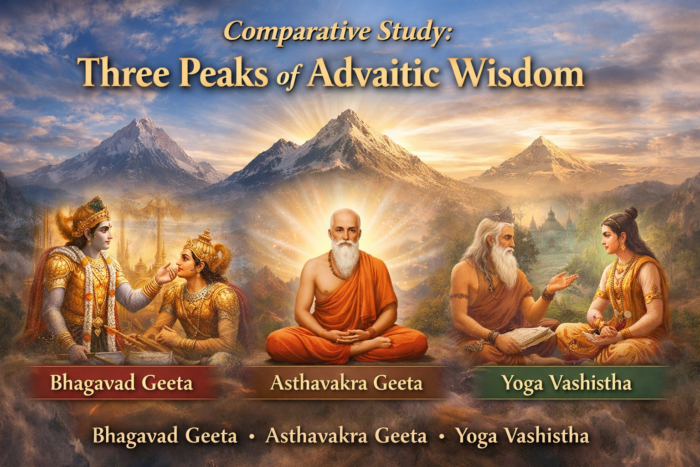
    Indian spiritual literature presents many voices, yet certain texts stand like mountain summits in the landscape of non-dual wisdom. Among them, the Bhagavad Gita, Ashtavakra Gita, and Yoga Vasistha offer profound explorations of liberation, the Self, and the nature of reality.

    Though rooted in Advaita (non-duality), their tone, method, and approach differ remarkably. Together, they form a complete spectrum — from active engagement in the world to radical transcendence of it.

    2.  The Setting of the Dialogue

    The context of each scripture shapes its teaching.

    The Bhagavad Gita unfolds on the battlefield of Kurukshetra. Arjuna, overwhelmed by moral confusion, refuses to fight. His crisis is ethical and emotional. The teaching arises in the midst of action and responsibility.

    The Ashtavakra Gita occurs in the quiet court of King Janaka. There is no battlefield, no moral dilemma. The discussion is purely philosophical — a dialogue between an enlightened sage and a prepared seeker yearning for immediate liberation.

    The Yoga Vasistha takes place in the royal court of Ayodhya. Prince Rama, after witnessing the impermanence of life, falls into deep existential reflection. His crisis is not moral but metaphysical — a disillusionment with cyclic existence (Samsara).

    Thus, each begins with sorrow — but of different kinds: moral, spiritual, and existential.

    3. The Prime Goal of Each Text

    All three seek liberation (Moksha), yet define and approach it differently.

    The Bhagavad Gita teaches liberation through harmony — integrating action, devotion, meditation, and knowledge. Its message is balance: perform duty without attachment and surrender to the Divine.

    The Ashtavakra Gita teaches immediate awakening through pure knowledge. It declares that bondage is illusion and that one is already free. No gradual process is emphasized — only direct recognition.

    The Yoga Vasistha teaches liberation through understanding the nature of mind. It analyzes how consciousness projects the world and how ignorance creates Samsara. Liberation comes from dissolving mental constructions.

    4. Their View of the World

    In the Bhagavad Gita, the world is a manifestation of the Divine. It is real as an expression of cosmic order. One must engage with it responsibly.

    In the Ashtavakra Gita, the world is pure illusion — like a mirage or dream. It has no independent reality apart from consciousness.

    In the Yoga Vasistha, the world is described as a projection of mind — dream-like and dependent on perception. It is neither fully real nor absolutely unreal, but mind-born.

    5. The Role of Action

    The Bhagavad Gita places great emphasis on action (Karma Yoga). It insists that inaction is impossible. One must act, but without attachment to results.

    The Ashtavakra Gita minimizes action entirely. It asserts that action does not bind or liberate — only ignorance does. Realize the Self, and action loses significance.

    The Yoga Vasistha explains that action originates from mental imagination. When the mind is understood and purified, action continues naturally without bondage.

    6. Concept of God and Self

    The Bhagavad Gita presents a personal Divine — Krishna as Supreme Reality — while also affirming the impersonal Absolute.

    The Ashtavakra Gita speaks almost exclusively of the Self. There is no emphasis on a personal God; the Self alone exists.

    The Yoga Vasistha describes pure consciousness as ultimate reality. God is not separate from awareness; the universe arises within consciousness.

    7. Method and Tone

    The Bhagavad Gita is balanced, devotional, and practical. It speaks to warriors, householders, and seekers engaged in life.

    The Ashtavakra Gita is radical and uncompromising. It demands maturity and detachment. Its language is direct and absolute.

    The Yoga Vasistha is philosophical and narrative. It uses stories, metaphors, and deep psychological analysis to guide the seeker gradually.

    8. Similarities — The Common Core

    Despite differences, they share profound unity:

    • The Self is eternal and unborn.
    • Ignorance causes suffering.
    • Detachment is essential.
    • Liberation is recognition of true nature.
    • Inner freedom is the highest goal.

    All three ultimately affirm: You are pure consciousness beyond body and mind.

    9. For the Modern Seeker

    • If one is deeply involved in society and duty, the Bhagavad Gita offers guidance on living spiritually within action.
    • If one feels profound detachment and seeks immediate truth, the Ashtavakra Gita offers uncompromising clarity.
    • If one is philosophically inclined and wishes to understand the mechanics of mind and illusion, the Yoga Vasistha provides expansive insight.
    • Together, they do not contradict but complement each other.

    Quick Comparison of Three Advaitic Texts

    Aspect Bhagavad Gita Ashtavakra Gita Yoga Vasistha
    Context Battlefield dialogue between Krishna and Arjuna Philosophical dialogue between sage Ashtavakra and King Janaka Dialogue between sage Vasistha and Prince Rama
    Main Focus Duty, devotion, and selfless action Direct realization of the Self Understanding the nature of mind and illusion
    View of the World Manifestation of the Divine Illusory appearance within consciousness Projection of the mind
    Path to Liberation Karma, Bhakti, Jnana, and meditation Immediate knowledge of the Self Inquiry into consciousness and dissolution of mental constructs
    Ideal Seeker One engaged in worldly duties Mature seeker ready for direct insight Philosophically inclined spiritual aspirant

    10. Conclusion — Three Rivers, One Ocean

    The Bhagavad Gita teaches how to act in the world without bondageThe Yoga Vasistha teaches how the world arises within consciousness.
    The Ashtavakra Gita declares that the world never truly bound you.

    One harmonizes life.
    One analyzes illusion.
    One dissolves illusion instantly.

    Yet all point to the same realization:

    You are not the changing phenomena.
    You are the changeless awareness in which all appears.

    Three dialogues.
    One Truth.

    Advaita Ashtavakra Gita Bhagavad Gita Hindu Philosophy Self-Realization Spiritual Texts Vedanta yoga vashistha
    Share. Facebook Twitter Pinterest LinkedIn WhatsApp Reddit Tumblr Email
    GANPAT VYAS
    • Website

    I am Ganpat Lal Vyas son of late Shri Madan Lal Vyas and late Smt Rukmani Devi. Curiosity has always been the guiding force of my life. I am a science graduate with post-graduation in economics and served in banking for my livelihood. From my early studies, especially science, I was deeply inspired to explore beyond textbooks and classrooms. Though professional life limited deep academic pursuit, the thirst to know never faded. After retirement, I am free to explore the unknown realms of science, philosophy, and existence. This website reflects my lifelong journey of inquiry and learning.

    Related Posts

    Awakening of Janaka : Aastavakra Geeta

    March 17, 2026

    Sagun vs. Nirgun: Two Paths to the Divine

    March 10, 2026

    The Bhagwad Geeta : AI Blueprint for Robotic Age

    March 6, 2026
    Leave A Reply Cancel Reply

    Pick Your Language
    Facebook X (Twitter) Instagram Pinterest
    © 2026 ThemeSphere. Designed by ThemeSphere.

    Type above and press Enter to search. Press Esc to cancel.