



Introduction
The great war of Kurukshetra had finally ended. The battlefield that once echoed with the clash of weapons now lay silent. Victory had come to the Pandavas, yet it brought little joy.
This moment of reflection forms the heart of the Shanti Parva Mahabharata, the “Book of Peace.” Instead of describing battles, this section explores the deeper questions that arise after war: responsibility, governance, justice, and the search for inner peace.
The Pandava king Yudhishthira stood victorious, but his heart was filled with sorrow. The cost of victory had been immense. Teachers, relatives, and friends had perished in the conflict.
In this state of moral despair, Yudhishthira questioned the very meaning of power and kingship.
A King Burdened by Victory
Yudhishthira did not feel like a conqueror. Instead, he felt responsible for the destruction of the Kuru lineage.
He began to doubt whether ruling a kingdom gained through war could ever be righteous. The thought of renouncing the throne and retreating into the forest began to grow within him.
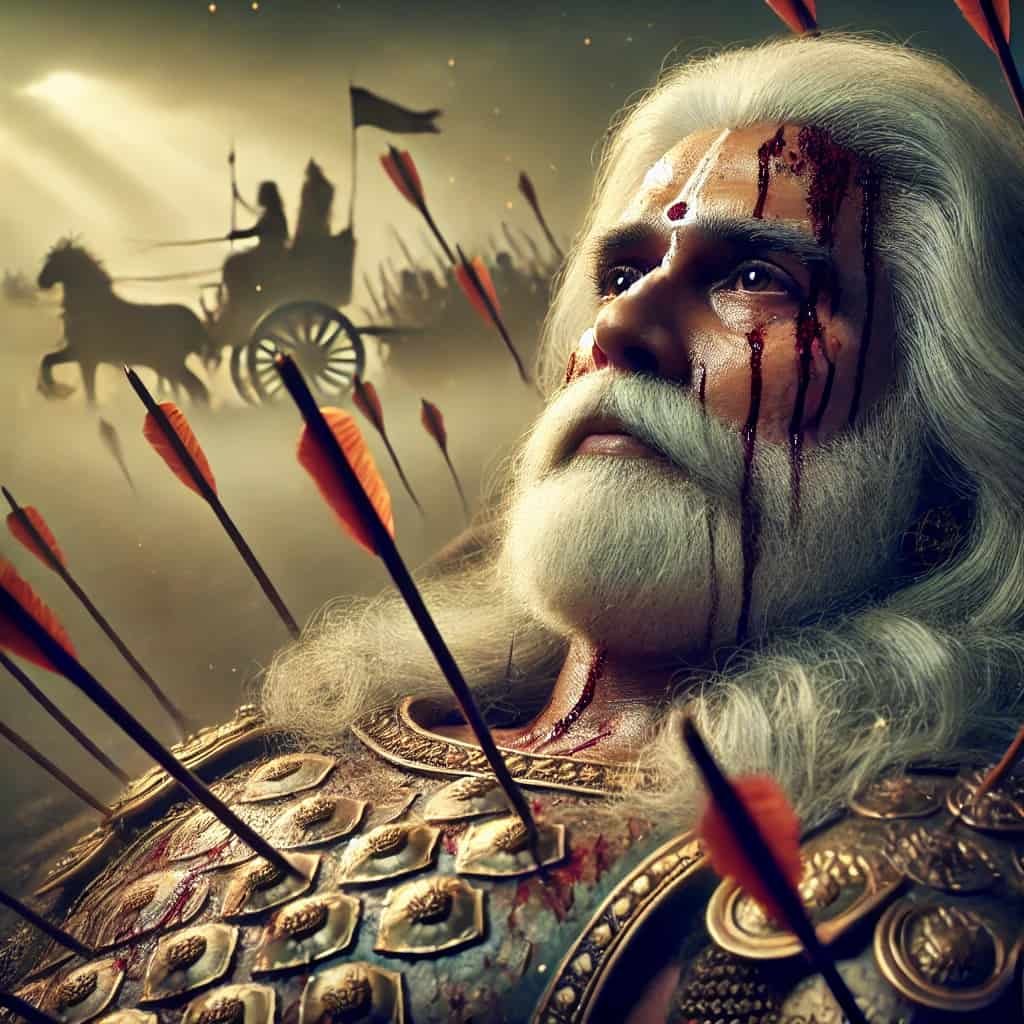
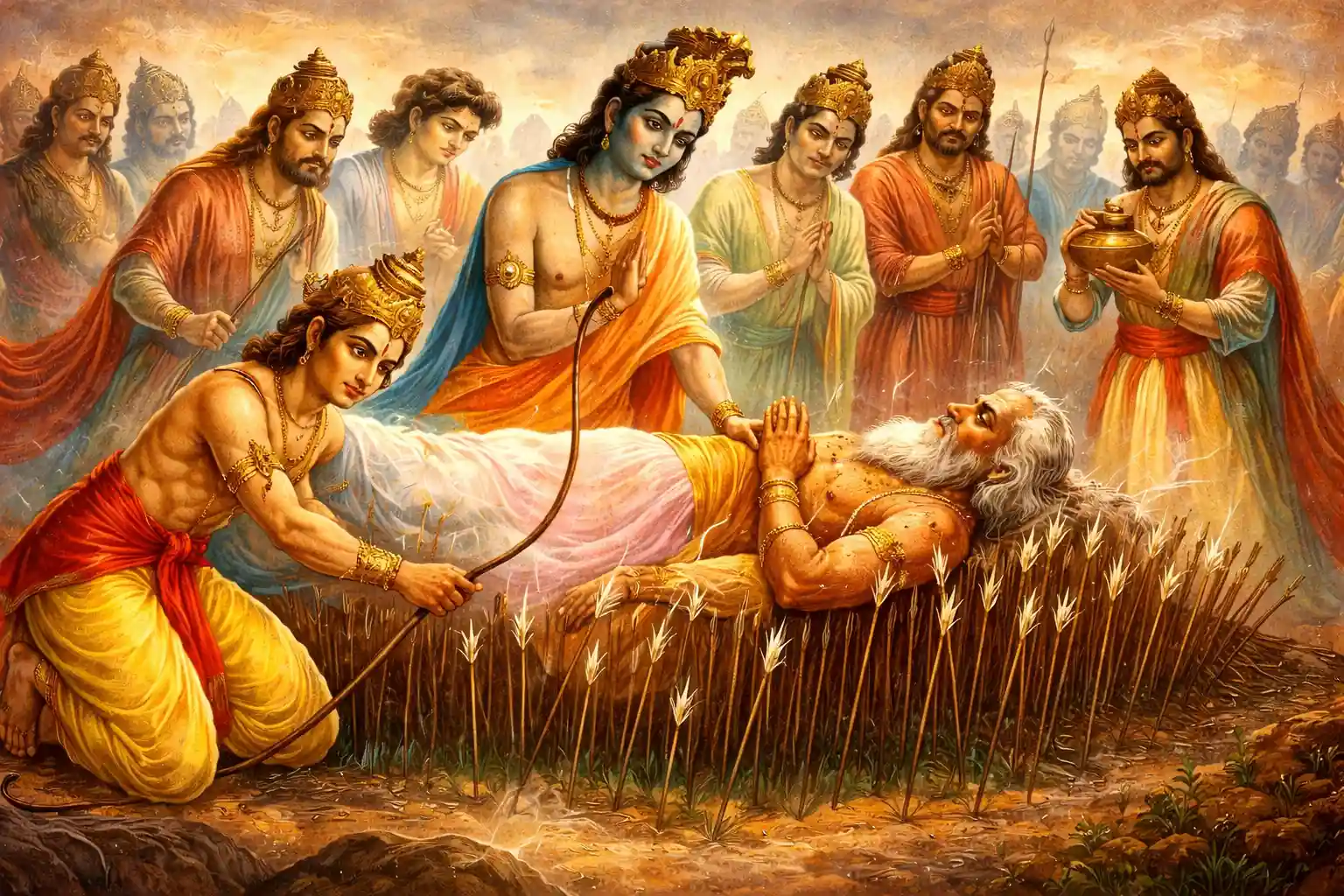
Krishna and the Pandavas realized that such despair could not guide the future of the kingdom. Therefore they led Yudhishthira to the battlefield where Bhishma, the grandsire of the Kuru dynasty, still lay alive on a bed of arrows.
Bhishma had chosen to delay his death until the auspicious moment of Uttarayana. During this time he became the teacher of the victorious king.
Thus begins the great dialogue of the Shanti Parva Mahabharata.
Bhishma’s Teaching on Rajadharma
The first major theme of the Shanti Parva is Rajadharma, the duty of a king.
Bhishma explained that renouncing the throne would not solve the suffering of the kingdom. The people needed stability, protection, and wise governance.
According to Bhishma, a king must serve as the guardian of justice. Without a ruler who upholds law and order, society would descend into chaos.
He described the concept of Danda, the authority of law and discipline. Just as a shepherd protects his flock, a king must protect his people.
However, this power must never become tyranny. The ruler must govern with fairness and compassion.
Apaddharma — Ethics in Times of Crisis
Life does not always present clear moral choices. For this reason Bhishma introduced the idea of Apaddharma, the ethical conduct appropriate during times of crisis.
In extraordinary situations, strict rules may need to be adapted for survival. Bhishma illustrated this idea through various stories and parables.
One such example describes the alliance between natural enemies when faced with a greater danger. Another story shows how hospitality and compassion must remain even in difficult circumstances.
These teachings reveal the Mahabharata’s realistic understanding of morality. Dharma is not always rigid. It requires wisdom and discernment.
Mokshadharma — The Path to Liberation
After discussing governance and practical ethics, Bhishma turned to a deeper subject: Mokshadharma, the path toward spiritual liberation.
Here the Shanti Parva Mahabharata moves beyond politics and enters the realm of philosophy.
Bhishma explained the nature of the Atman, the eternal Self that remains unchanged even as the body perishes. He also described the influence of the three gunas—Sattva, Rajas, and Tamas—which shape human behavior and perception.
Through meditation, self-discipline, and knowledge, a seeker can transcend these forces and realize the true nature of consciousness.
Thus the Shanti Parva connects worldly duty with spiritual wisdom.
The Psychological Healing of Yudhishthira
The teachings of Bhishma gradually transformed Yudhishthira’s state of mind.
He began to understand that leadership does not mean personal glory. Instead it means responsibility toward the well-being of society.
Bhishma reminded him that even a painful victory could serve a greater purpose if the kingdom was governed with justice.
The despair of the king slowly gave way to clarity.
The Significance of Shanti Parva
The Shanti Parva Mahabharata serves several important purposes within the epic.
First, it provides a philosophical pause after the devastation of war. Readers are invited to reflect on the meaning of power, duty, and morality.
Second, it presents one of the earliest and most detailed discussions of political philosophy in Indian literature.
Third, it bridges the worldly responsibilities of governance with the spiritual aspiration for liberation.
For this reason the Shanti Parva is often regarded as an encyclopedia of ancient Indian thought.
Lessons for the Modern World
The questions raised in the Shanti Parva remain relevant even today.
Modern leaders face similar dilemmas: how to exercise authority without losing moral integrity, and how to balance power with compassion.
Bhishma’s answer lies in the principle of Nishkama Karma—performing one’s duty without attachment to personal gain.
Peace is not simply the absence of conflict. True peace arises when justice, wisdom, and responsibility guide human actions.
Conclusion
The Peace That Follows War
As Bhishma completed his teachings, Yudhishthira’s doubts began to dissolve. The king realized that abandoning responsibility would not heal the wounds of the kingdom.
Instead he accepted the throne with humility and determination to rule with justice.
The Shanti Parva Mahabharata therefore reminds us that the deepest battles occur not on the battlefield but within the human mind.
After the noise of war fades, wisdom must guide the rebuilding of society.
- Series Articles Readers may follow the series to understand how the epic moves from moral collapse to diplomacy, war, and finally wisdom.
-
Mahabharata 18 Parvas – Structure of the Epic https://lifedevote.com/the-mahabharat-18-parvas/
-
Sabha Parva – When Silence Became Sin https://lifedevote.com/when-silence-became-sin/
-
Udyoga Parva – The Last Door to Peace https://lifedevote.com/udyoga-parva-mahabharata-krishnas-peace-mission/
-
Shanti Parva – The Silence That Teache https://lifedevote.com/?p=3602&preview=true
The Shanti Parva is described in the classical Sanskrit Mahabharata text. Link: https://www.sacred-texts.com/hin/m12/index.htm
