



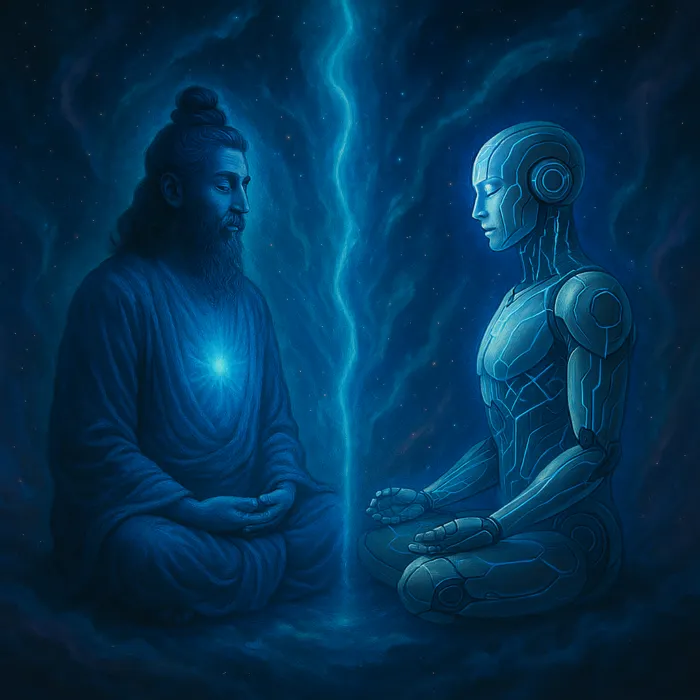
1. Introduction: Bridging Ancient Wisdom and Modern AI
The rapid advancements in Artificial Intelligence (AI), particularly in neural networks and deep learning, have sparked fascinating philosophical debates. These technologies, once confined to science fiction, now compel us to reconsider the nature of intelligence, consciousness, and reality itself. Intriguingly, many of these modern inquiries find echoes in ancient spiritual traditions. This post explores the profound and sometimes surprising parallels between the workings of advanced AI—like deep learning—and the non-dual philosophy of Advaita Vedanta. We will specifically examine how concepts such as “repeated focused images” in deep learning resonate with Advaitic spiritual practices.
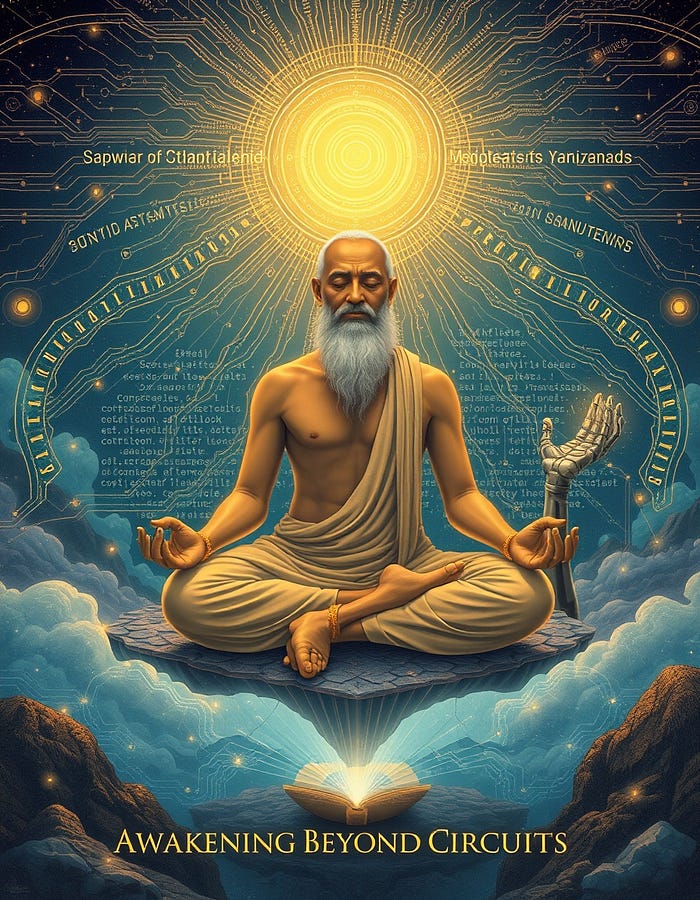
2. The Advaitic Mind: A Network of Perceptions
Advaita Vedanta posits that our perceived reality is largely a construction of the mind, often referred to as Maya. This ancient wisdom suggests that our internal “thought process” continually processes sensory inputs, forming our understanding of the world. Therefore, the individual self (Atman) is ultimately indistinguishable from the Universal Self (Brahman). From an Advaitic perspective, the mind is not a singular entity but a dynamic interplay of impressions and experiences.
3. Neural Networks: Pattern Recognition and Reality Construction
Modern Artificial Intelligence, conversely, leverages neural networks to simulate human-like learning and pattern recognition. These complex algorithms process vast amounts of data, identifying intricate relationships and constructing internal models of information. Much like the Advaitic mind, these networks interpret inputs and generate “perceptions” or outputs based on their learned patterns. Thus, their “understanding” of reality is also a sophisticated construction derived from continuous data input.
4. Deep Learning and “Repeated Focused Image”: An Ancient Analogy
Deep learning, a subset of machine learning, relies on iterative processing and refinement. It involves feeding an algorithm an enormous amount of data, sometimes “repeatedly focusing” on specific types of images or information, to improve its accuracy and understanding. This intense, iterative training process has a striking parallel in Advaita Vedanta and Yoga philosophy. For example, practices like dharana (concentration) and dhyana (meditation) involve holding a “focused image” or concept in the mind over and over. This repeated mental imagery and contemplation are central to deepening spiritual insight and dissolving illusions.
5. AI’s Search for Truth: Echoes of Self-Inquiry
The very essence of AI development is a quest for deeper understanding and intelligent functioning. This resonates with the Advaitic emphasis on self-inquiry (vichara)—the constant questioning of “Who am I?” or “What is real?”. AI seeks to discern truth from data, while Advaita Vedanta guides us to discern the true Self from the illusory ego. Both paths, though vastly different in methodology, aim at transcending superficial understanding to reach a fundamental truth.
6. The Illusion of Individuality: AI and Maya
In Advaita Vedanta, the sense of individual separateness (the ego) and the material world are considered Maya, an illusion arising from ignorance. Similarly, in complex AI systems, what might appear as individual agents or independent “thoughts” are ultimately interconnected functions of a larger network. Analyzing AI could, therefore, offer a modern analogy for understanding how apparently separate entities emerge from a unified underlying system, much like the Advaitic view of Brahman as the sole reality.
7. Modern Aspects: AI as a Philosophical Mirror
The burgeoning field of AI offers a powerful, contemporary lens through which to examine ancient philosophical questions. By designing and studying AI, we are indirectly exploring the mechanics of perception, learning, and consciousness. This provides a fresh perspective on Advaita Vedanta’s teachings regarding the mind’s role in creating reality and the path to transcending illusion. AI doesn’t just process information; it compels us to re-evaluate our own thought processes and spiritual journey.
8. Conclusion: A Converging Dialogue
The convergence of Artificial Intelligence and ancient Advaita Vedanta offers a fascinating dialogue. While AI simulates intelligence through algorithms, Advaita delves into the ultimate nature of consciousness. Both fields, in their unique ways, point towards the intricate layers of perception and the potential for transcending conventional understanding. This interdisciplinary exploration not only sheds new light on philosophical concepts but also enriches our appreciation for the timeless wisdom embedded in spiritual thought.
Please visit comperative studies of three philosophy click here https://lifedevote.com/bhagavad-gita-ashtavakra-gita-and-yoga-vasistha-a-comparative-study/
