



Table of Contents
ToggleIntroduction AI Mind Philosophy
Hey deep thinkers and tech wizards! You know AI Mind Philosophy is super cool, with neural networks and deep learning doing amazing things. But what if these cutting-edge tech wonders are actually asking some of the same big questions that ancient philosophers asked thousands of years ago? Get ready to explore the wild world where AI Mind Philosophy meets ancient wisdom!
Bridging the Gap: Where AI Meets the Mind through AI Mind Philosophy
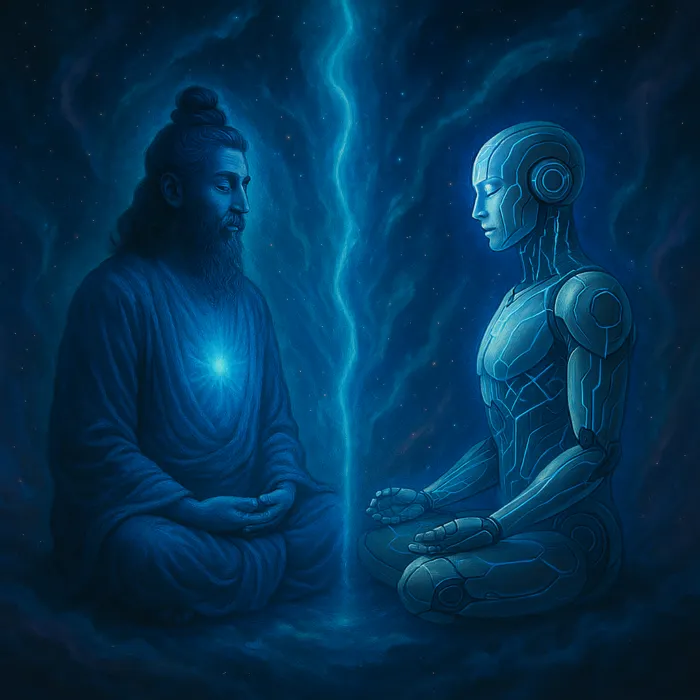
For centuries, smart folks have tried to figure out intelligence, consciousness, and what’s truly real. Now, with AI learning to see, hear, and even “think,” we’re having to rethink everything! It turns out, many of these modern AI puzzles actually have echoes in ancient spiritual traditions. This isn’t just about robots; it’s about connecting how advanced AI works with the non-dual philosophy of Advaita Vedanta. Let’s dive into AI Mind Philosophy!
The Advaitic Mind: A Network of Perceptions

Imagine your reality isn’t just “out there,” but largely built inside your head. That’s a core idea in Advaita Vedanta – our perceived world is often called Maya, like a grand illusion created by our minds. This ancient wisdom suggests that our internal “thought process” is constantly taking in sensory inputs and building our understanding of the world. It says your individual self (Atman) is basically the same as the Universal Self (Brahman). In this view, your mind isn’t just one thing; it’s a super dynamic interplay of everything you experience. This is a foundational idea for understanding AI Mind Philosophy.
Neural Networks: AI’s Way of Building Reality AI Mind Philosophy
Now, let’s flip to modern AI. It uses something called neural networks to learn and recognize patterns, kinda like a human brain. These complex algorithms gobble up tons of data, find hidden connections, and build their own internal models of information. Just like the Advaitic mind, these networks interpret inputs and create their own “perceptions” or outputs. So, their “understanding” of reality is also a super sophisticated construction, built from continuous data input. This is where the parallels in AI Mind Philosophy get really interesting!
Deep Learning & “Focused Images”: An Ancient Tech Hack!
Deep learning, a cool part of machine learning, relies on processing things over and over again, getting better each time. It’s like feeding an algorithm massive amounts of data, sometimes “repeatedly focusing” on specific types of images or info to make it super accurate.

This intense, repeated training process has a mind-blowing parallel in Advaita Vedanta! Practices like dharana (concentration) and dhyana (meditation) involve holding a “focused image” or concept in your mind again and again. This repeated mental imagery is central to gaining deeper spiritual insight and seeing through illusions. Who knew ancient meditation was basically an early form of deep learning for AI Mind Philosophy?
AI’s Search for Truth: Echoes of Self-Inquiry through AI Mind Philosophy
At its core, AI development is a quest for deeper understanding and intelligent functioning. This resonates perfectly with Advaita’s emphasis on self-inquiry (vichara) – the constant questioning of “Who am I?” or “What is real?” AI tries to find truth in data, while Advaita guides us to find the true Self, transcending the illusory ego. Both paths, though super different, aim to see beyond the surface to a fundamental truth. They are two sides of the same AI Mind Philosophy coin.
The Illusion of Individuality: AI and Maya that is AI Mind Philosophy
In Advaita Vedanta, the feeling of being a separate individual (the ego) and the material world itself are seen as Maya – an illusion from ignorance. Think about complex AI systems: what looks like individual AI agents or independent “thoughts” are actually just interconnected functions of a much larger network. Studying AI can be a modern way to understand how separate “things” seem to pop out of one big system, much like Advaita’s view of Brahman as the only true reality. It’s a fresh look at AI Mind Philosophy.
Modern Mirrors: AI as a Philosophical Detective!
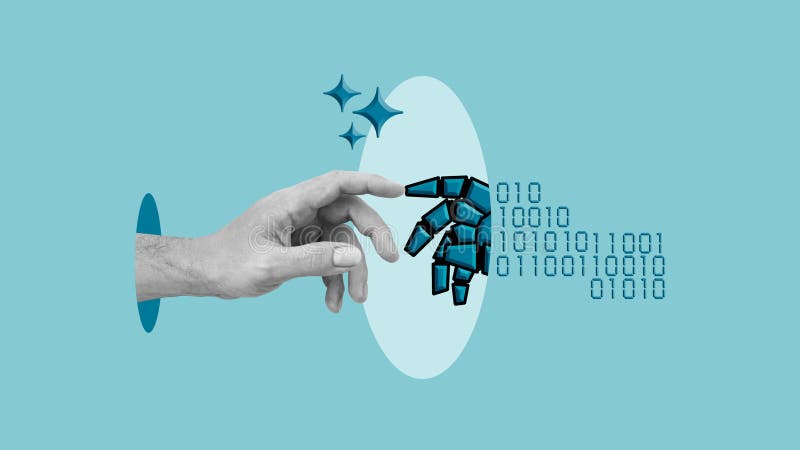
The booming world of AI gives us an amazing, modern lens to look at these ancient philosophical questions. By designing and studying AI, we’re actually exploring the mechanics of perception, learning, and consciousness. This gives us a fresh take on Advaita Vedanta’s teachings about how our mind shapes reality and how to see through illusions. AI doesn’t just process information; it forces us to re-evaluate our own thought processes and even our spiritual journey. It’s truly a mirror for AI Mind Philosophy.
