


Table of Contents
ToggleHey, Ever Felt Judged by How You Look? Or Judged Someone Else?
We live in a world obsessed with appearances, right? Perfect profiles, curated feeds, the “ideal” body, the “right” clothes. We make snap judgments in milliseconds based on what we see. But what if the most profound wisdom, the most liberating truth, came from someone who defied every single one of those visual expectations?
Welcome to the epic, mind-bending world of the Ashtavakra Gita, and meet its star: Ashtavakra. This isn’t your typical wisdom teaching, and Ashtavakra certainly wasn’t your typical guru. In fact, his story kicks off with a challenge to everything we think we know about judging a book by its cover.
The Original Glitch in the Matrix: Who Was Ashtavakra?
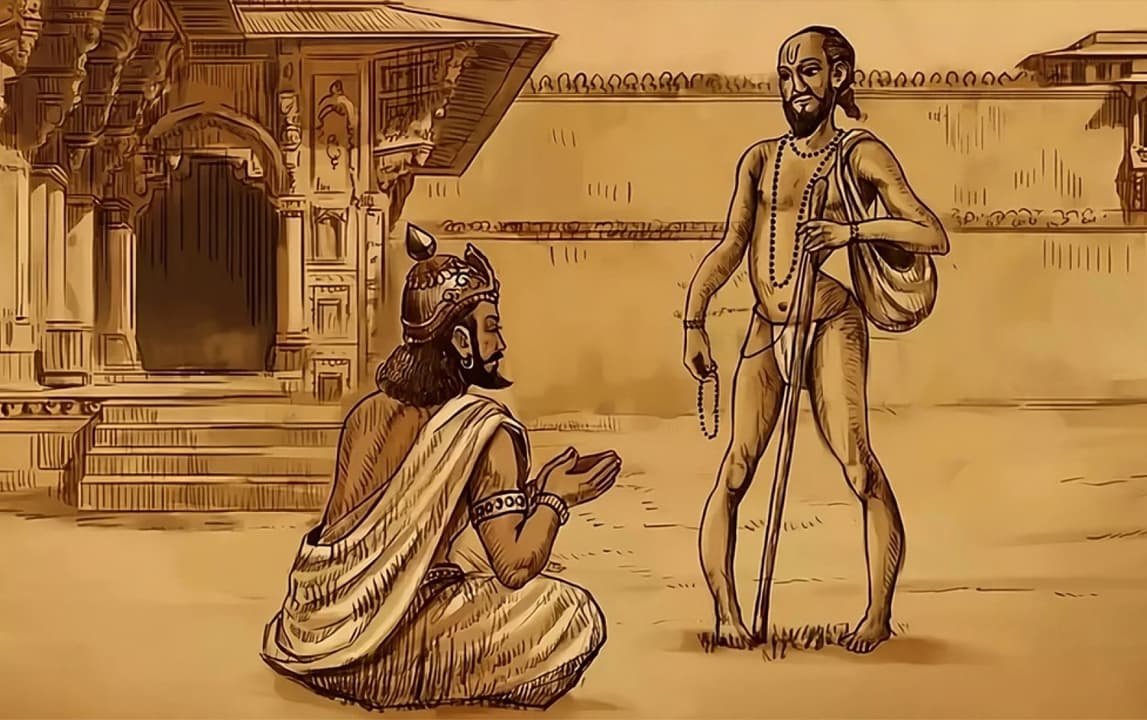
Imagine this: a huge gathering of learned scholars, wise men, and a powerful King Janaka (who, by the way, was pretty much at the top of his game spiritually, unlike Arjuna, who started out in total despair). Everyone is dressed impeccably, looking super serious and intellectual.
Then, walks in Ashtavakra.
His name literally means “eight-bends,” because his body was bent in eight places. He had physical deformities from birth. When he entered this assembly of “perfect” scholars, they couldn’t help themselves. They started laughing. Not a polite chuckle, but loud, dismissive laughter.
Most people, upon being mocked for their appearance, would probably shrink, get angry, or feel humiliated. Not Ashtavakra.
He looked around at these supposedly wise, learned men, and he started laughing back. And not just laughing, but laughing even harder than them!
The Punchline: “You’re Just Leather-Workers!”
Confused, King Janaka asked, “Sage, why do you laugh at my assembly?”
Ashtavakra’s reply was the ultimate mic-drop moment, the first “shock” in a series he’d deliver:
“I heard there was an assembly of learned men here. But all I see are ‘leather-workers’!”
Ouch. What did he mean?

He meant that these so-called wise men were so caught up in judging his body – the “leather” or “skin” – that they couldn’t see the consciousness, the wisdom, the real being within. They were looking at the packaging, not the profound message inside. They were literally “body-shaming” him and, in doing so, revealing their own superficiality.
This was Ashtavakra’s first lesson, delivered instantly: True wisdom sees beyond the apparent, beyond the physical form, beyond the outer shell.
Why This Sage Is Your Ultimate Teacher Today
In our highly visual, filter-heavy, avatar-driven digital world, Ashtavakra’s very existence is a powerful, living challenge to our perception.
- Challenging the Avatar: We create and project perfect digital avatars of ourselves. We judge others’ “avatars” instantly. Ashtavakra forces us to ask: What’s beyond the avatar? What’s the real player, the real consciousness behind the screen?
- The Glitch as Truth: His bent body was a “glitch” in the expected “perfect human” program. Yet, that “glitch” was the very thing that revealed the deeper truth: that the true Self is impervious to physical form, untouched by outward appearance. Just like a powerful piece of software can run perfectly even if the casing of the computer is dented.
- Freedom from Judgment: Ashtavakra teaches us to look past the surface, not just in others, but in ourselves. How often do we let our own appearance, or our perceived flaws, define our worth or limit our potential?
Ashtavakra wasn’t just a sage; he was a living, breathing unconventional guru, whose appearance itself was a teaching. He reminds us that the quest for truth isn’t about looking a certain way, or fitting into a mold. It’s about seeing beyond all appearances, all judgments, all expectations.
This was just the introduction. King Janaka, intrigued and probably a little embarrassed, was about to get an even deeper, more immediate shock that would change his life forever.
For Deeper Exploration & Unconventional Wisdom:
- Read the Ashtavakra Gita: This text is pure, undiluted wisdom. Many translations are available, some focusing on clarity for modern readers. Check out versions by SRI RAMANASRAMAM. (External Link)
