



Introduction
One Truth, Three Pathways of Advaitic Wisdom
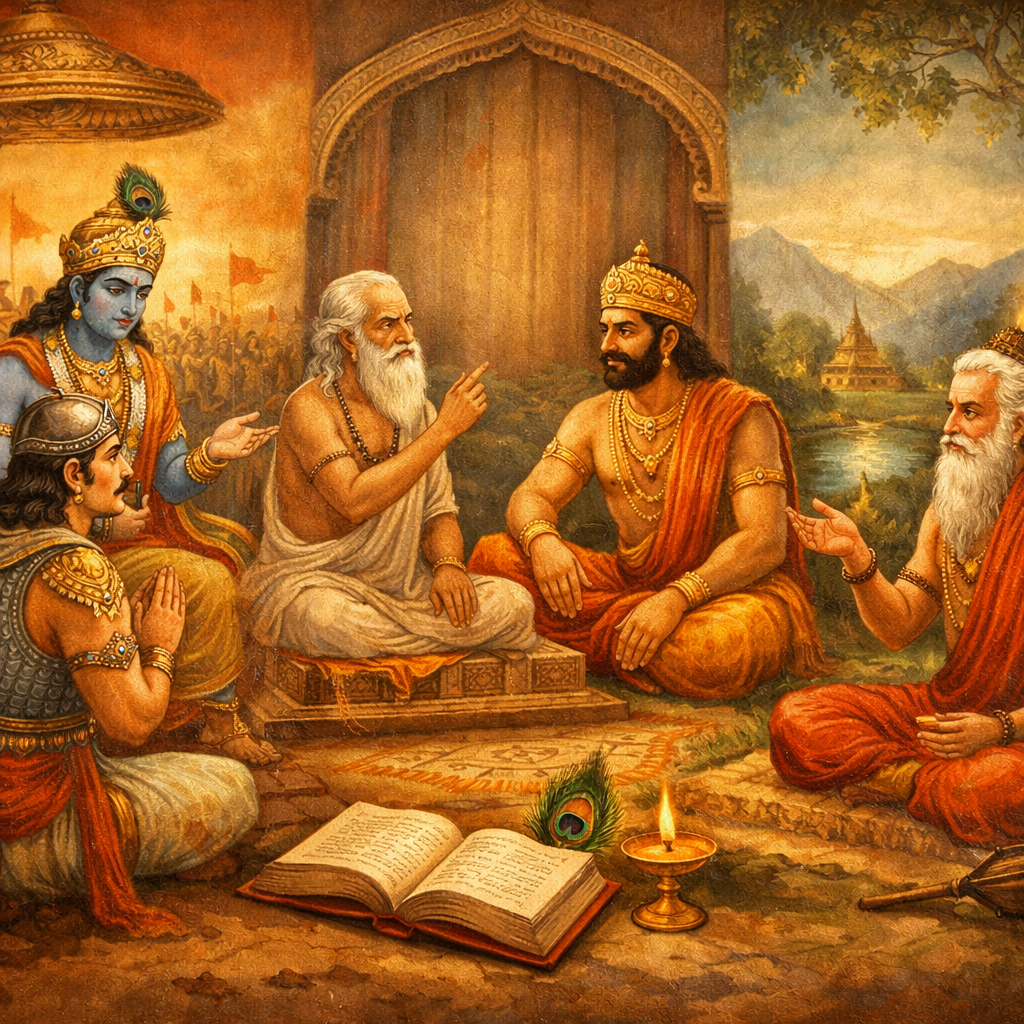
Indian spiritual literature speaks in many voices, yet certain texts rise like mountain peaks in the landscape of non-dual wisdom. Among them the Bhagavad Gita, Ashtavakra Gita, and Yoga Vasistha stand as three profound explorations of the nature of the Self, consciousness, and liberation.
Though rooted in the vision of Advaita (non-duality), their tone and method differ remarkably. One teaches through action in the world, another through immediate self-knowledge, and the third through deep philosophical inquiry into the nature of mind.
Together they reveal a complete map of spiritual understanding.
I. The Setting of the Dialogue
Three Different Human Crises
Each scripture begins with a different human crisis.
The Bhagavad Gita arises on the battlefield of Kurukshetra. Arjuna faces a moral and emotional conflict. His paralysis reflects the ethical dilemmas of human life.
The Ashtavakra Gita unfolds in the peaceful court of King Janaka. The dialogue here is purely philosophical. The seeker already possesses maturity and seeks direct realization.
The Yoga Vasistha takes place in the royal court of Ayodhya. Prince Rama experiences a deep existential disillusionment with worldly life.
Thus the starting point of each text differs:
-
moral crisis
-
philosophical inquiry
-
existential awakening
II. The Path Toward Liberation
Three Approaches to Moksha
All three texts pursue Moksha, liberation from ignorance.
The Bhagavad Gita teaches integration. Action, devotion, meditation, and knowledge all work together.
The Ashtavakra Gita presents a radical vision. Liberation occurs through immediate recognition of one’s true nature.
The Yoga Vasistha explores the workings of the mind. Liberation arises when mental constructions dissolve.
III. Their Understanding of the World
Reality, Illusion, and Mind
The three texts offer different perspectives on the world.
The Bhagavad Gita sees the universe as a divine manifestation. It is real as an expression of cosmic order.
The Ashtavakra Gita describes the world as an illusion, like a dream appearing within consciousness.
The Yoga Vasistha presents a subtle middle position. The world arises from the projections of mind and therefore possesses a dream-like nature.
IV. The Role of Action
Karma and Freedom
In the Bhagavad Gita, action is unavoidable. The teaching of Karma Yoga instructs individuals to act without attachment.
The Ashtavakra Gita minimizes the importance of action. It declares that ignorance alone creates bondage.
The Yoga Vasistha explains that action originates in imagination. When the mind becomes free, actions continue but no longer bind the individual.
V. The Concept of God and the Self
Personal and Impersonal Reality
The Bhagavad Gita presents Krishna as the Supreme Being while simultaneously affirming the impersonal Brahman.
The Ashtavakra Gita focuses almost entirely on the Self. The ultimate reality is pure awareness.
The Yoga Vasistha describes consciousness as the ground of existence, where the universe appears like waves in an ocean.
VI. Method and Teaching Style
Each text speaks to a different type of seeker.
The Bhagavad Gita addresses individuals engaged in worldly responsibilities.
The Ashtavakra Gita speaks to seekers ready for immediate realization.
The Yoga Vasistha employs stories, metaphors, and philosophical reflection to gradually unfold understanding.
VII. Their Common Core
Despite their differences, the three scriptures share fundamental insights.
• The Self is eternal.
• Ignorance creates suffering.
• Detachment is necessary for liberation.
• True freedom lies in recognizing one’s real nature.
All three ultimately affirm a simple yet profound truth:
You are not the changing phenomena of life.
You are the awareness in which all experiences appear.
Quick Comparison of Three Advaitic Texts
| Aspect | Bhagavad Gita | Ashtavakra Gita | Yoga Vasistha |
|---|---|---|---|
| Context | Battlefield dialogue between Krishna and Arjuna | Philosophical dialogue between sage Ashtavakra and King Janaka | Dialogue between sage Vasistha and Prince Rama |
| Main Focus | Duty, devotion, and selfless action | Direct realization of the Self | Understanding the nature of mind and illusion |
| View of the World | Manifestation of the Divine | Illusory appearance within consciousness | Projection of the mind |
| Path to Liberation | Karma, Bhakti, Jnana, and meditation | Immediate knowledge of the Self | Inquiry into consciousness and dissolution of mental constructs |
| Ideal Seeker | One engaged in worldly duties | Mature seeker ready for direct insight | Philosophically inclined spiritual aspirant |
Final Philosophical Reflection
Three Rivers Flowing Toward One Ocean
The Bhagavad Gita teaches how to live and act in the world without bondage.
The Yoga Vasistha explains how the world arises within consciousness.
The Ashtavakra Gita declares that the Self was never bound in the first place.
Thus three dialogues unfold across different contexts, yet they converge toward a single realization.
Three teachers.
Three paths.
One truth.
Frequently Asked Questions
1. What is the main difference between the Bhagavad Gita and the Ashtavakra Gita?
The Bhagavad Gita teaches spiritual wisdom through action, devotion, and duty, while the Ashtavakra Gita emphasizes immediate realization of the Self through pure knowledge.
2. How does the Yoga Vasistha differ from the other two texts?
Yoga Vasistha focuses on the nature of mind and illusion, explaining how consciousness creates the experience of the world.
3. Are these texts based on Advaita philosophy?
Yes. All three texts reflect the principles of Advaita or non-dual philosophy, though each presents the teaching through a different method.
4. Which text is easier for beginners?
The Bhagavad Gita is generally considered more accessible because it balances philosophy with practical guidance for daily life.
