



Table of Contents
ToggleThe Elephant King’s Journey from Struggle to Surrender and Ultimate Liberation
There’s something incredibly relatable and deeply human in the ancient tale of Gajendra Moksha. Beyond its mythical setting of lush forests, serene lakes, powerful elephants, and lurking crocodiles, this story speaks directly to a universal human experience: feeling trapped, battling exhaustion, and the profound, liberating power of surrender.
The Crisis: When Strength Meets an Unyielding Grip
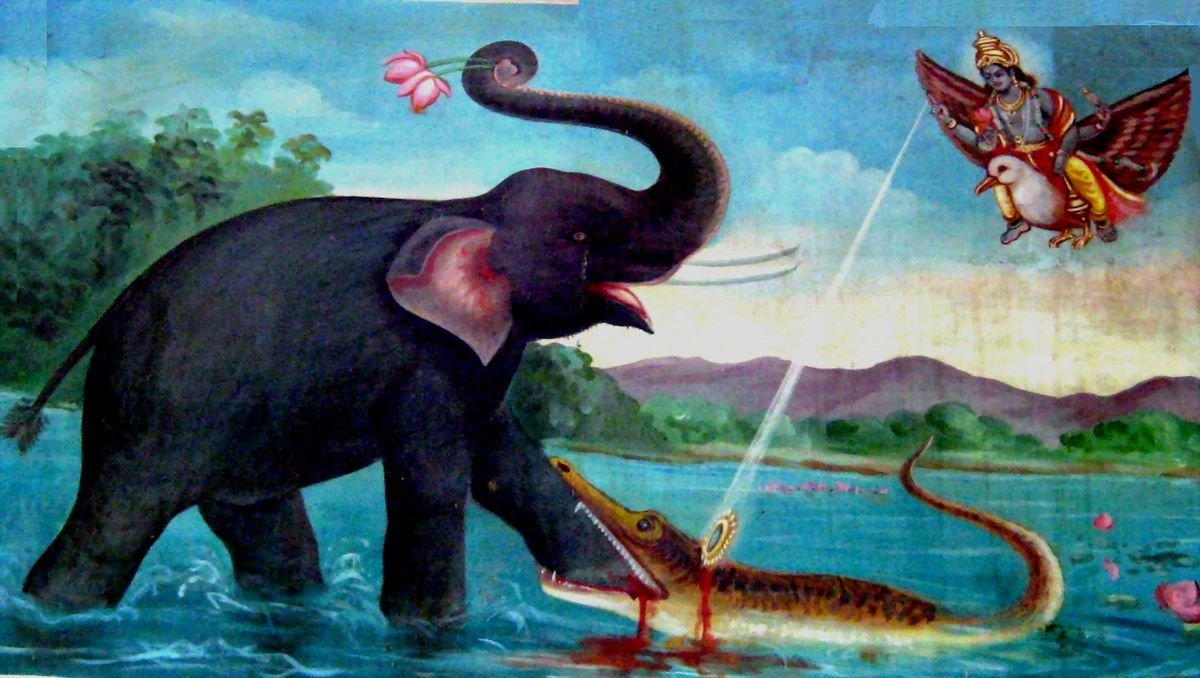
Gajendra wasn’t just any elephant; he was the majestic king of his herd, brimming with confidence and power. One tranquil day, he entered a cool lake with his companions, feeling secure and in control – much like we often do when life is flowing smoothly. But then, without warning, a crocodile seized his leg.
His initial reaction was primal: pure, unadulterated force. He thrashed, pulled, and fought with every ounce of his massive strength. The lake became a chaotic battlefield, churned by his struggle. His herd trumpeted in alarm, trying desperately to help. Yet, the crocodile was in its element, and the longer Gajendra fought, the weaker he became. This moment, as ancient wisdom reveals, is often the very beginning of deeper understanding.
The Metaphor: Our Inner Battle with Attachment
The lake in the story beautifully represents our comfortable world of experiences – our relationships, successes, and even our sense of identity. We navigate it with confidence, believing we are masters of our destiny. The crocodile, however, isn’t an external monster; it embodies the subtle yet powerful grip of attachment. This includes our desires, fears, pride, ingrained habits, and the ever-present ego. Initially, we believe our inherent strength, intelligence, or social support can overcome these internal forces. But the more we struggle blindly against them, the more entangled we become.
This epic battle, which some traditions say lasted for years, vividly mirrors our own prolonged cycles of effort and exhaustion. We try countless strategies, resist, blame external circumstances, and fight harder. Yet, the grip of our attachments often doesn’t loosen. Why? Because we are fighting on the crocodile’s home ground. Trying to defeat attachment while still fully immersed in desire and ego is, inherently, a losing proposition.
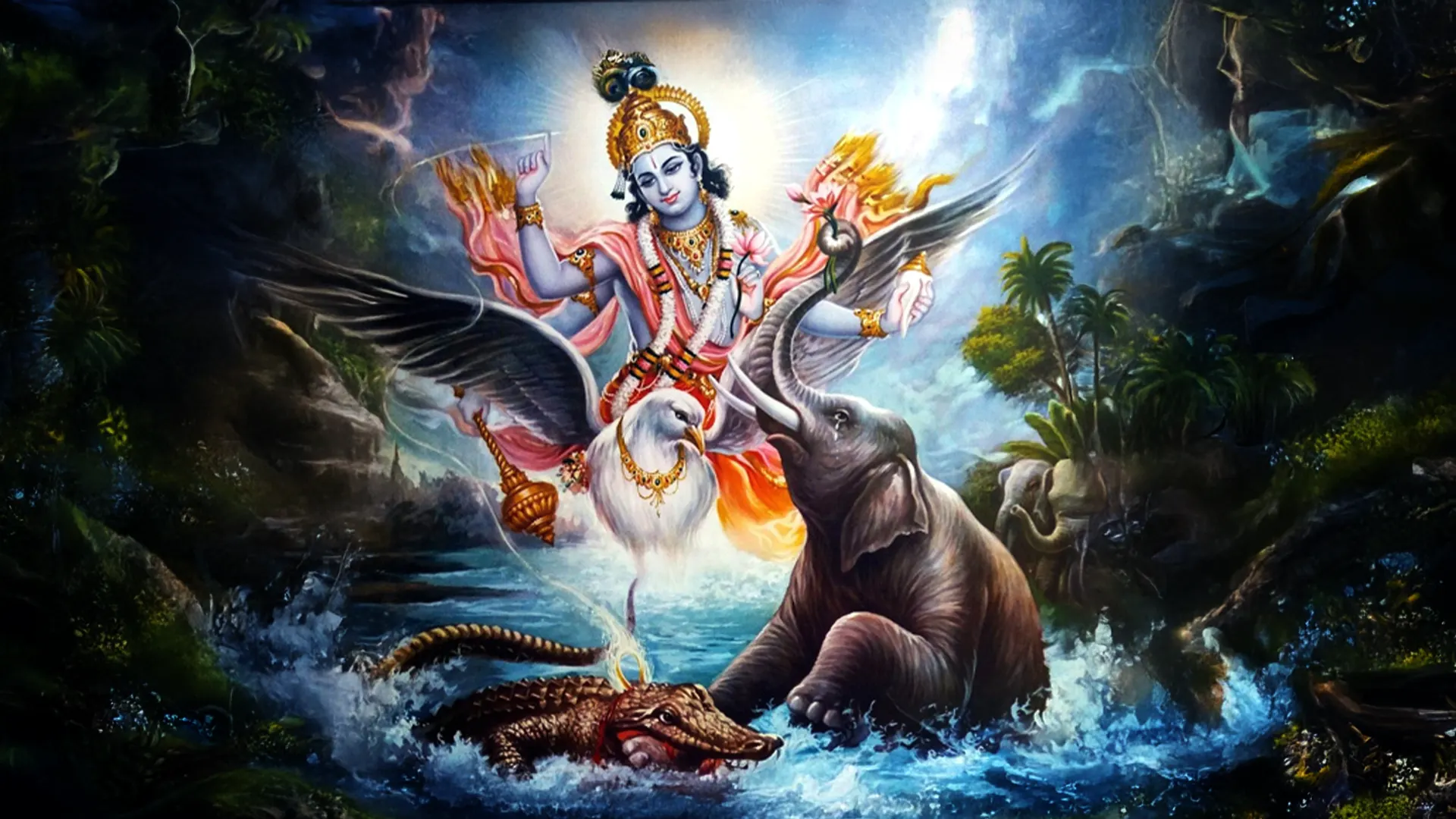
Crocodile and Gajendra request for rescue
The Turning Point: Exhaustion and the Cry of Surrender
Gradually, Gajendra’s immense strength failed him. His mighty body trembled, his loyal companions stood helpless, his kingly pride dissolved, and his once-unshakeable confidence crumbled. All that remained was raw, complete vulnerability. It’s at this luminous, exhausted moment that the story truly shines.
Gajendra stops fighting. He ceases the struggle and, with his trunk, raises a single lotus flower towards the sky. He cries out – not in anger, not in bargaining, but in absolute, profound surrender. His appeal isn’t complex theology; it’s a raw, honest declaration: “I cannot save myself.”
This is the pivotal turning point. Detachment doesn’t begin with a withdrawal from the world, but with an honest recognition of our own limitations. As long as we believe our egoic strength makes us self-sufficient, the futile struggle continues. But when we truly acknowledge that the grip of samsara – the endless cycle of attachment and suffering – cannot be broken by force alone, something within us softens. Samsara isn’t merely literal rebirth; it’s the repetitive pattern of craving, struggle, fleeting relief, and renewed entanglement. The crocodile, then, is a symbol of this very grasping, which is never truly external, but rather a reflection of our inner state.

Ultimate rescue
Liberation: Grace, Clarity, and a Deeper Awareness
When Gajendra finally surrenders, Lord Vishnu appears, freeing him from the crocodile’s grasp. This divine intervention symbolizes grace, a grace that isn’t arbitrary but responds directly to clarity. When the incessant noise of the ego subsides, a deeper awareness becomes profoundly accessible. In psychological terms, surrender means releasing our compulsive identifications – recognizing that “I” am not defined solely by my roles, possessions, or the image I project. The elephant king had to shed his pride to discover humility; his prolonged struggle had to exhaust his ego to awaken true devotion.
The story teaches that detachment is not cold indifference. Gajendra didn’t reject the lake because it was inherently evil. He simply discovered that his dependence on it for security was misplaced. True freedom didn’t come from abandoning life, but from a radical shift in his center of identity. After his liberation, Gajendra is no longer just an animal king; he becomes a symbol of the awakened soul. And in many narratives, even the crocodile finds release, a poignant reminder that even our adversaries can play a role in our awakening.
The Stages of Spiritual Awakening
This myth profoundly humanizes our spiritual struggles. It doesn’t deny pain or romanticize suffering. Instead, it outlines a universal path:
- Confidence
- Crisis
- Effort
- Exhaustion
- Surrender
- Liberation
Detachment from samsara doesn’t imply escaping responsibility or withdrawing from love. It means no longer being dragged under by every fluctuation of life. The “lake” can still be enjoyed; life can still be lived fully. But the unconscious, desperate grip of attachment loosens.
We all encounter our “crocodiles.” They might manifest as ambition, resentment, fear of loss, an addiction to validation, or a desperate need for control. Initially, we naturally fight harder. Yet, eventually, wisdom whispers: perhaps the struggle itself is what sustains the grip.
The Lotus: A Symbol of Unstained Awareness
Gajendra’s raised lotus flower is arguably the most powerful image in the entire narrative. The lotus, growing in muddy waters yet rising pristine and unstained above the surface, symbolizes inner purity amidst worldly entanglement. When he lifts the lotus, he elevates his awareness above mere reaction.
In that singular, profound gesture lies true detachment. It is not withdrawal. It is not defeat. It is, instead, a profound surrender to a deeper ground of being.
The story of Gajendra Moksha beautifully invites us to ask: What if genuine freedom isn’t achieved by overpowering life, but by recognizing the eternal awareness that is never truly bound? When the elephant ceases his fight with the water and turns inward, his struggle transforms. The lake is no longer a battlefield; it becomes a background. The crocodile loses its dominance. The desperate cry transforms into a prayer. And that prayer, in turn, becomes absolute clarity.
And clarity, ultimately, becomes liberation.
In the end, this timeless story reassures us: even in the deepest, most desperate struggles, awakening is always possible. The grip of samsara may feel absolute – until our awareness turns inward, towards its own source. Like Gajendra, we may fight for years. But when our strength finally fails and genuine surrender arises, something far greater begins to move within us. And in that sacred movement, we are truly freed.
