



When Our Brains Started Talking to Machines (Seriously!)
Hey future innovators! Ever felt like your brain is always processing tons of information, just like a supercomputer? Well, you’re not wrong! For centuries, scientists just studied things like how the world moved or how life began. But then, in the 1900s, something wild happened: people started asking not just “How does my mind work?” but “Can we build something that thinks like us?”
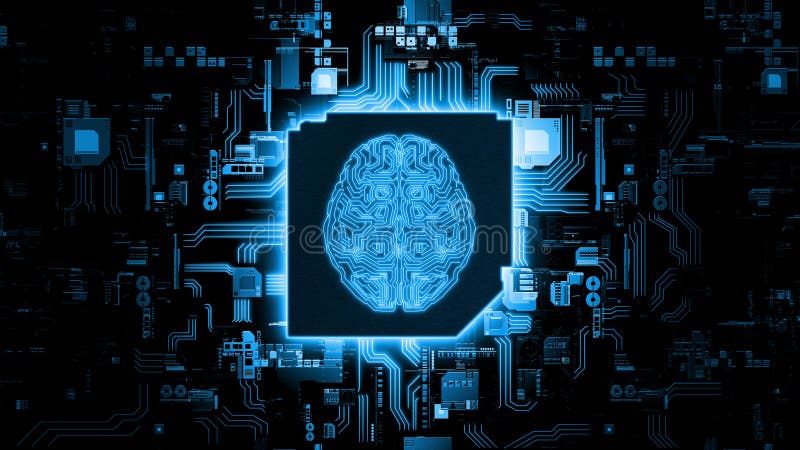
It was like curiosity hit a whole new level! Could our thoughts, our logic, our ways of figuring things out, be broken down into steps so clear that a machine could follow them? Suddenly, thinking wasn’t just biology; it became all about computation – fancy word for how computers solve problems.
Meet the Masterminds: Turing & Shannon

Two legendary thinkers really kickstarted this digital revolution:
- Alan Turing: The Codebreaker Who Dreamed of Thinking Machines Imagine a super-secret codebreaker during a war, who then goes on to imagine a machine that could solve any problem, as long as you gave it clear rules. That was Alan Turing! He came up with the idea of a “Turing machine” – not a physical machine at first, but a concept that showed how anything that can be described step-by-step could, in theory, be done by a computer. This was revolutionary because it meant thought itself could be mechanized!
- Claude Shannon: The Guy Who Defined “Information” Around the same time, Claude Shannon figured out what “information” really is. Before him, information was kind of a vague idea. But he showed how to measure it, send it efficiently, and even optimize it using bits (those 0s and 1s you hear about!). He basically laid the groundwork for all digital communication. Think about it: just like tiny atoms combine to make complex molecules, simple 0s and 1s combine to make everything you see on your screens right now!
The Digital Explosion: From Calculators to Supercomputers

Thanks to these brilliant minds, computers went from clunky calculators to powerful electronic brains. Suddenly, curiosity had these incredible tools to explore even more!
- Science got a turbo-boost: Weather forecasts became way better, genetic research zoomed ahead, and even exploring quantum physics got easier with computer simulations.
- Your brain got an upgrade: You could say the human mind actually extended itself through machines. We could process more data, faster, and collaborate globally in ways never before possible.
The digital age isn’t just about cool gadgets; it’s about how information flows, how decisions are made (often with algorithms helping out), and how knowledge is growing at warp speed!
The Million-Dollar Question: Can Machines Really Think?
But all this awesome tech brought up some seriously deep questions:
- Is calculating the same as understanding? A machine can solve a super hard math problem, but does it know what it’s doing? Does it understand the numbers?
- What about creativity, emotions, or adapting to new situations? Human intelligence is so much more than just following rules. Can a computer ever truly be creative, or feel something?

Neuroscience, the study of our brains, shows that our minds work through vast networks of neurons sending electrical signals – basically, sophisticated pattern processing. This gave rise to machine learning, where computers learn to find patterns in huge amounts of data and get better over time, just like our brains do!
The line between what’s “biological” (us) and “artificial” (machines) started to blur.
The Mirror Effect: What Do Machines Tell Us About Ourselves?
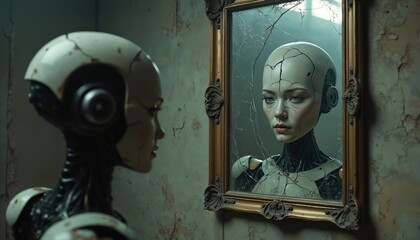
For the first time ever, we built systems that actually mimic parts of how we reason and think. These machines aren’t alive, they don’t grow up, but they can learn, write, and solve crazy complex problems.
It’s like humanity built a giant mirror. And when we look into it, it reflects back aspects of our own minds. But this mirror isn’t just cool; it asks some big, sometimes unsettling, questions:
- If a machine can be intelligent, what makes us uniquely human?
- If computers can process info way faster than us, what’s our special role in the future?
The Next Big Question: Can Curiosity Replicate Itself?

The digital age is more than just a new chapter; it’s a whole new evolutionary moment – not for our bodies, but for our technology. Evolution shaped our brains, and now technology is extending them.
But there’s one final, epic question that keeps scientists and philosophers up at night:
Can our human curiosity create something that then becomes curious itself? Can artificial systems not just compute, but actually wonder and inquire?
This brings us to the next, mind-bending step in our journey: The Age of Artificial Intelligence.
From the smallest bits of matter to the wonder of life, to the complexity of the mind, to the power of machines… and now, perhaps, from machines to something we can barely even imagine.
Click here to explore the next frontier: The Age of Artificial Intelligence: Can Curiosity Replicate Itself?
