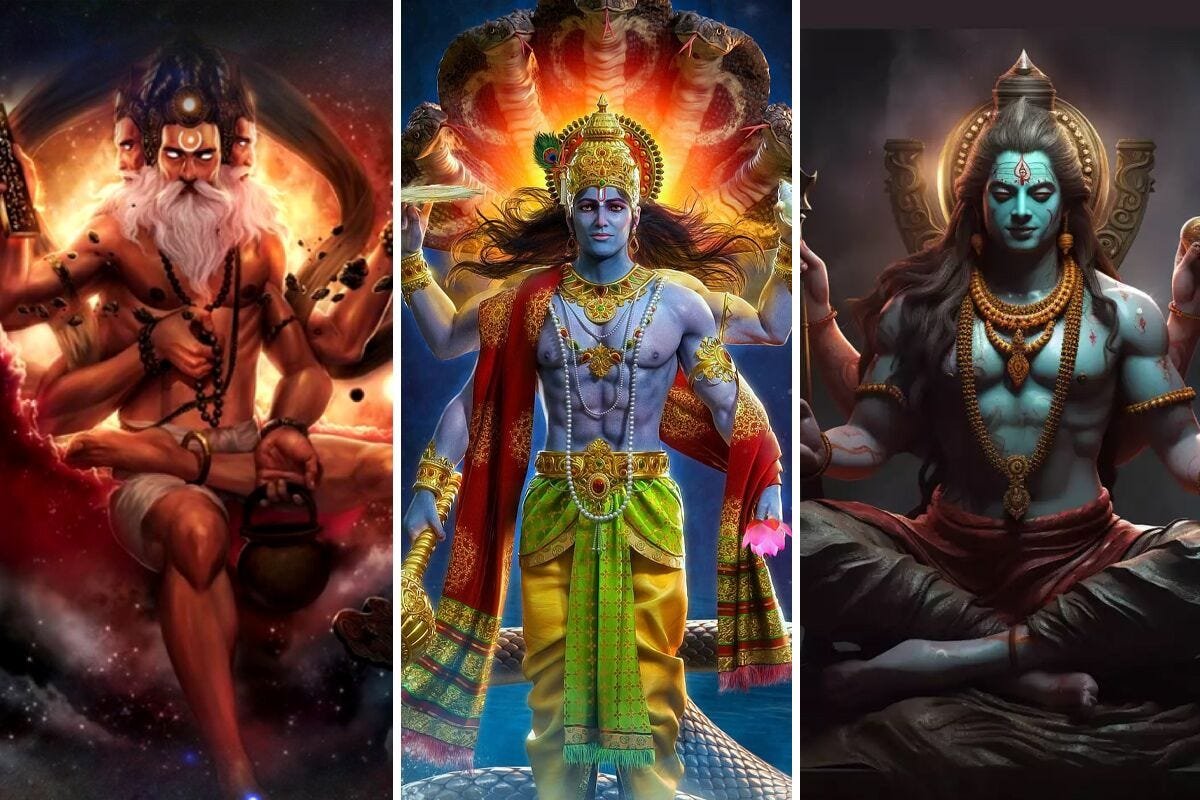
After the subtle mystery of the Nasadiya Sukta, Indian mythology presents a dramatic cosmic event: Samudra Manthan. This myth transcends its imagery, symbolizing the disciplined process of inner refinement. The ocean embodies the depth of consciousness, containing both dormant negativity and hidden potential. The mountain signifies focused effort, while the serpent represents dynamic, directed energy. As life is “churned” through inquiry and self-examination, inner struggles like confusion and ego surface first—an unavoidable step towards transformation. Only by skillfully balancing opposing forces does clarity emerge. The “nectar of immortality” thus represents awakened awareness, recognizing consciousness’s own depth and freedom. This myth teaches that profound growth requires patience, resilience, and equilibrium, showcasing tension as a catalyst for cosmic, psychological, and spiritual evolution.
The Ocean of Becoming and the Birth of Nectar
The ocean’s constant motion beautifully depicts “becoming”—life’s ceaseless flow of change, holding both destructive and transformative potentials. This churning of the ocean signifies deep engagement and intense inquiry, activating hidden depths. Initially, turbulence, confusion, and shadow emerge like poison; yet, this disturbance is a necessary step towards refinement. The “nectar” signifies clarity, wisdom, and freedom born from this struggle and sustained effort. It arises from within the process itself, not as an external gift. Ultimately, illuminated understanding—the nectar of insight—is born from holding tension steadily within the waves of transformation.
Kurm Awtar
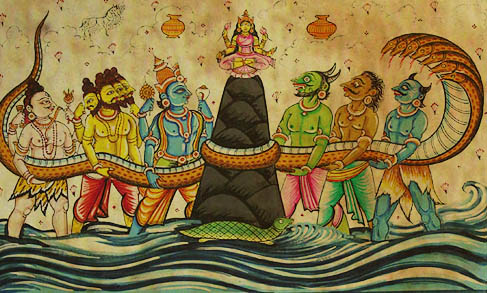
The Samudra Manthan, or the Churning of the Ocean of Milk, is a pivotal cosmic event. In this dramatic myth, even sworn enemies—the Gods (Devas) and anti-Gods (Asuras)—temporarily unite for a singular, monumental purpose: to churn the vast cosmic ocean and retrieve Amrita, the coveted nectar of immortality. Far from being a mere tale, this is a profound allegory reflecting evolution, deep psychology, and spiritual awakening. Unlike Greek myths that often highlight order emerging from chaos, or Norse myths that portray life as a growing tree, Indian mythology, through the Samudra Manthan, uniquely reveals transformation through tension.
Churning Ocean
1. The Cosmic Setup — Cooperation of Opposites
The Samudra Manthan reveals a core philosophical truth: profound transformation necessitates the cooperation of opposites. The weakened Devas and powerful Asuras, traditionally foes, were compelled to unite to churn the cosmic ocean and retrieve the life-giving Amrita hidden within its depths. Neither could succeed alone. This setup symbolizes how light and shadow, positive and negative tendencies (Devas and Asuras), are essential, complementary forces in evolution. Mount Mandara, the churning rod, represents stability (axis of consciousness), while the serpent Vasuki, the rope, embodies dynamic energy. The ocean itself signifies infinite consciousness, the field of this transformation. Ultimately, the myth teaches that growth, whether cosmic, psychological, or spiritual, thrives on the creative tension generated by integrating contrasting energies rather than suppressing them.
Lord Vishnu KurmAwtaar
2. Kurma — The Tortoise Foundation
When Mount Mandara, the churning rod, began to sink during the Samudra Manthan, Vishnu took the form of Kurma, the giant tortoise, to provide support from below. This powerful image teaches a crucial lesson: all transformative effort needs a stable foundation. While the mountain represents aspiration and focused action, without deep inner grounding, even the grandest endeavors falter. Kurma, with its enduring steadiness, symbolizes that essential inner stability—the patience, resilience, and unwavering balance required beneath life’s inevitable turbulence. Psychologically, it signifies the calm, centered awareness that sustains growth through difficulty. Just as a physical system needs structural support for energy flow, our inner churning demands a foundation of stillness. This ensures that dynamic evolution is not only possible but sustainable, with chaos supported by a steadfast base.
3. The First Emergence — Poison (Halahala)
As the Samudra Manthan began, the first horrifying emergence was not nectar, but Halahala—a deadly poison threatening universal destruction. This powerful sequence teaches that when consciousness is stirred by effort or crisis, hidden toxicities like fear, ego, and confusion often surface before any true treasure. Transformation, therefore, doesn’t start with immediate clarity, but with an often uncomfortable confrontation with these internal “poisons.”
In this moment of ultimate peril, Lord Shiva compassionately intervened, drinking the Halahala to save creation. He held the poison in his throat, which turned blue, earning him the name Neelkantha. Shiva’s act symbolizes a crucial psychological insight: negative forces must be consciously acknowledged and contained, not denied or allowed to spread. By bravely facing and integrating these inner shadows, we enable the refinement process, making the emergence of true wisdom and illumination possible.
Shri Lakshmi Came out by churning
4.The Emergence of Treasures
After the world-threatening Halahala was contained, the continued churning of the cosmic ocean began to yield an array of wondrous treasures. These weren’t random gifts; they were symbolic emergences of latent virtues and potentials, surfacing only after the confrontation and containment of destructive forces. Among these were the radiant Goddess Lakshmi (prosperity), Kamadhenu (the wish-fulfilling cow), Airavata (the divine elephant), and Kalpavriksha (the wish-granting tree).
Philosophically, these treasures represent the profound qualities cultivated through sustained effort and inner struggle: the prosperity of wisdom, the abundance of compassion, newfound strength, and boundless creative possibility. They teach us that our inner churning, when met with steadiness, gradually releases hidden capacities and transforms conflict into constructive integration. These gifts, arising from the depths, pave the way for the ultimate nectar, signifying that true growth is a step-by-step refinement process.
5. Amrita — The Nectar of Immortality
Finally, after the immense cosmic effort, the Amrita—the nectar of immortality—emerged from the ocean’s depths. Symbolically, this highly sought-after essence doesn’t promise physical eternal life, but rather the profound realization of a timeless dimension within consciousness itself. It signifies insight, a recognition of that which is not subject to decay. This “immortality” represents liberation from the fear of change, not an escape from change itself, arising only after enduring tension, confronting poison, and undergoing gradual refinement.
Even at this culmination, conflict reemerged as the Asuras attempted to seize the Amrita exclusively, requiring divine intervention to restore balance. This highlights that ego can still try to appropriate enlightenment. True immortality, as the myth teaches, isn’t about selfish possession, but about awakening—an understanding that beneath the ceaseless flux of becoming, there exists a continuity of awareness untouched by birth and death. The Amrita, then, is the distilled essence of transformation: when our inner opposites are harmonized and consciousness remains steady through turmoil, we discover a depth within ourselves that transcends time.
The Vasuki Naag and Mandaar parvat
6. The Serpent as Energy
In the dramatic Samudra Manthan, the mighty serpent Vasuki isn’t merely a rope; it serves as the dynamic force coiling around Mount Mandara, pulled by both Gods and Asuras. This powerful imagery symbolizes dynamic energy itself—the vital, raw power that fuels all transformation. Vasuki, coiled and potent, embodies latent potential, a force capable of both creation and destruction depending on its direction, much like the concept of Kundalini in Indian yogic thought, representing dormant spiritual energy awaiting awakening to higher awareness.
Energy is inherently neutral; its outcome is determined by how it’s balanced and guided. Pulled recklessly, it breeds chaos; held steadily, it propels movement toward refinement. The alternating pull of opposing forces—Devas and Asuras—illustrates that energy is activated through polarity. Just as electrical currents arise from positive and negative charges, our inner vitality is stimulated by the tension between contrasting tendencies. This serpent-as-energy reminds us that true transformation isn’t about suppressing force but rather engaging with it in a disciplined manner. Life itself is a constant oscillation between joy and sorrow, gain and loss, order and entropy. From this very oscillation, from the harnessed serpent’s tireless movement, comes growth, allowing the ocean of becoming to ultimately yield its precious nectar of insight.
7. Ocean as Conscious Field
In the symbolism of Samudra Manthan, the ocean transcends a mere physical expanse; it represents the boundless field of consciousness itself. Like an ocean with countless currents and hidden depths, consciousness holds our thoughts, emotions, memories, and latent potentials. The churning of this ocean symbolizes the deliberate activation of this inner field through inquiry, reflection, or intense experience. When undisturbed, its contents remain latent, but through engagement, deeper layers—both toxic and luminous—emerge.
This view of the ocean as a conscious field suggests that reality is not just external but an experiential depth. All phenomena, from initial “poison” to eventual “nectar,” arise within this field. The myth underscores that through deep self-examination, we stir these depths, first encountering challenges, then gaining insight. Recognizing this oceanic nature of consciousness reveals we are not isolated individuals, but movements within a shared, boundless expanse of awareness, making the myth both psychological and cosmic simultaneously.
8. Comparative Insight — East and West
Comparing the philosophical arcs of East and West reveals a striking convergence beneath their distinct symbols. Greek myths moved from Chaos to Cosmos, mirroring Vedic reflection on mystery before being. The Norse World Tree resonates with the Indian cosmic ocean, both illustrating reality as an organic process. Western alchemy’s transformation of lead to gold parallels the Samudra Manthan, where tension refines and hidden nectar emerges.
While the West often emphasizes rational structure and the East highlights consciousness and inward realization, both traditions acknowledge dynamic becoming, the creative role of opposites, and the possibility of deeper awareness. The common intuition is that reality is process, transformation is inevitable, and understanding matures through active participation in this unfolding whole. As all these traditions agree: transformation requires disturbance, for still water stagnates, but churned water yields essence.
9. Entropy and Disequilibrium
Scientifically, entropy describes systems tending toward increasing disorder or energy dispersion. While it might seem like a principle of decline, modern thermodynamics reveals that disequilibrium is actually essential for complexity. When energy differences exist, movement occurs, patterns form, and new levels of organization emerge. Without these gradients, there’s no flow, no life. Philosophically, entropy isn’t just decay; it’s a dynamic transformation where energy redistributes to create fresh configurations. Stars are born from imbalance, ecosystems thrive on instability, and thought itself arises from energetic gradients.
This means disequilibrium acts as a creative tension, echoing mythic motifs like the Samudra Manthan. The interplay of opposing forces creates motion, which in turn generates emergence and ultimately higher order. Thus, the myth beautifully symbolizes this evolutionary logic: without tension, no nectar can appear. Entropy, rather than being the enemy of structure, is the very condition through which more complex and profound forms of structure can unfold.
10. The Inner Churning of the Seeker
The Samudra Manthan finds its most profound meaning within the individual seeker. Here, the “ocean” becomes the depths of one’s own consciousness, and the opposing forces are our internal conflicts—desires, fears, aspirations, and doubts. When one sincerely turns inward through reflection, meditation, or disciplined inquiry, the superficial calm of habit is disturbed, revealing hidden emotions and old patterns. Much like the Halahala, initial confusion and discomfort often surface before any true inner nectar.
Yet, this inner turbulence is not a sign of failure; it is purification in motion, the friction necessary for growth. If the seeker remains steady—grounded like Kurma, absorbing the “poison” like Shiva, and persevering with patience—the churning gradually refines perception. Clarity emerges from chaos, and insight from tension. This inner churning transforms fragmentation into integration, leading to conscious presence and an awareness beyond fear, where wisdom is distilled from turmoil itself, yielding an individual “Amrita.”
11. The Dance Toward Integration
Transformation doesn’t end with conflict; it evolves into integration. This “dance toward integration” symbolizes the stage where opposing forces, rather than fighting for dominance, begin to harmonize within a broader awareness. Much like Nataraja’s cosmic dance beautifully balances creation and dissolution, the seeker learns to embrace and hold joy and sorrow, strength and vulnerability, action and stillness, not as fragmented parts but as integral aspects of a whole. This isn’t about erasing differences, but about aligning them into a functional coherence.
In this dynamic dance, tension transforms into coordination. The energies that once pulled in conflicting directions now move in complementary patterns. Insight arises when the mind stops rejecting one pole for another and recognizes their profound interdependence. This shift from conflict to coherence is the hallmark of psychological maturity, philosophical clarity, and spiritual awakening. Therefore, the Samudra Manthan is not merely a tale of gods triumphing over demons; it’s a powerful allegory for the cooperation of opposites. The Devas and Asuras symbolize tendencies within us, demonstrating that integration—not suppression—is what ultimately yields the nectar of wisdom. This aligns perfectly with the idea that consciousness evolves through inclusion, not rejection, orchestrating life’s complexities into a profound harmony.
Conclusion — The Ocean Within
The story of the churning ocean ultimately points inward, revealing that the vast cosmic sea is not some distant realm, but the profound depth of our own consciousness. Within this inner ocean reside hidden poisons of fear and attachment, latent treasures of virtue and strength, and the ultimate nectar of awakened insight. Life itself becomes the ceaseless churning, with experiences, relationships, struggles, and reflections continually stirring the waters of our becoming. The surface may at times be turbulent, at others serene, yet the immeasurable depth remains constant.
To recognize this “ocean within” is to grasp that true transformation isn’t externally imposed; it unfolds organically from the core of our awareness. When inner tension is met with steadiness, when our shadows are faced without denial, and when opposing forces are held in dynamic balance, clarity gradually emerges. The mythical nectar then becomes a lived realization—a quiet freedom discovered amidst constant change. Thus, this internal ocean serves as both the field and the teacher, containing the entire journey from initial disturbance to profound integration. In its depths, the seeker rediscovers not something entirely new, but the timeless expanse of awareness that has always been present beneath the waves. Indian mythology, therefore, transcends mere cosmic narration; it provides a powerful map for inner transformation. After the initial mystery (Nasadiya), comes the essential churning (Manthan).
I am Ganpat Lal Vyas son of late Shri Madan Lal Vyas and late Smt Rukmani Devi. Curiosity has always been the guiding force of my life.
I am a science graduate with post-graduation in economics and served in banking for my livelihood.
From my early studies, especially science, I was deeply inspired to explore beyond textbooks and classrooms.
Though professional life limited deep academic pursuit, the thirst to know never faded.
After retirement, I am free to explore the unknown realms of science, philosophy, and existence.
This website reflects my lifelong journey of inquiry and learning.