
Table of Contents
ToggleWhen Our Curiosity Built Its Own Brain (Kind Of!)
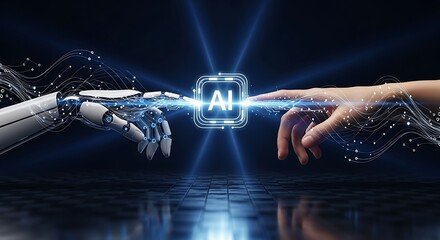
Hey future thinkers! We’ve come on an incredible journey: from watching simple things move, to breaking down matter, to figuring out the secrets of life itself. Each step expanded what we understood. But now, we’re in a whole new ballgame: The Age of Artificial Intelligence (AI)!
This isn’t just about faster computers. It’s about us, humans, building systems that seem to think, learn, and even create – almost like us! It’s like our curiosity didn’t just observe the universe anymore; it built a tool that appears to observe and understand. For the very first time, the human mind has engineered something that mirrors its own reasoning. Wild, right?!
The Official Birth of AI: A Bold Idea!
The term “Artificial Intelligence” wasn’t always around. It was officially cooked up in the mid-20th century by a super-smart dude named John McCarthy. His vision was simple but revolutionary: what if machines could do tasks that, if a human did them, we’d call them “intelligent”?
This wasn’t just about making robots that do chores. This was a super bold idea: if intelligence means solving problems, following rules, and learning, then maybe, just maybe, we could teach a machine to do that! The line between a simple tool and something that thinks started to get blurry.
Learning Without Being Alive?
Modern AI systems are incredible! Think about it:
- They don’t have brains or cells.
- They don’t eat or breathe.
- They don’t evolve through natural selection like living things.
Yet, they learn!

Through complex math (called neural networks, inspired by our brains) and by crunching massive amounts of data, AI can do amazing things: they write stories, compose music, help doctors diagnose illnesses, and predict complicated trends. They get better through feedback, constantly refining themselves.
But here’s the crucial part: learning is not living. While AI can learn faster than any human, this distinction is still super important.
Is It Intelligence, or Just a Really Good Imitation?

This brings us to the biggest question: when an AI writes a poem, does it understand what it’s saying? When it recognizes a picture of a cat, does it perceive the cat, or just recognize a pattern of pixels?
- AI processes information statistically. It maps patterns across huge datasets and makes educated guesses about what should come next.
- Human consciousness, however, has this inner, subjective experience – what it feels like to be you, to understand, to dream.
Science can model how our brains process information, but it hasn’t yet fully explained that inner “experience” of being conscious.
Curiosity Looking in a Mirror: The Poetic Loop
There’s something almost poetic about AI. Think about it:
- The universe evolved matter.
- Matter organized into life.
- Life evolved consciousness (that’s us!).
- Consciousness built machines.
- Now, those machines help consciousness!
It’s like our curiosity has created a reflection of itself. But a reflection isn’t the same as the real thing. AI can be super fast, have a perfect memory, and spot patterns no human can. But does it have intrinsic motivation? Does it ever ask, “Why do I exist?” Does it have dreams or fears?
Probably not, in the human sense. Humans ask “why?” AI processes “what.”
Power + Responsibility = Our Future!
Every big scientific leap has brought immense power. Fire kept us alive. Physics built industries. Chemistry gave us medicines. Now, AI amplifies our cognitive power! It speeds up research, transforms communication, and influences almost every part of our lives.
But with great power comes great responsibility! The question isn’t just “Can we build it?” but “How should we use it?”
If AI can simulate intelligence, what remains uniquely human? Maybe it’s not just about calculation or memory. Maybe it’s our ability to reflect on ourselves, to question our existence, our values, and what life truly means.
- AI processes information.
- Humans interpret existence.
- AI predicts.
- Humans wonder.
In humans, curiosity isn’t just about getting answers; it’s about the very act of existing and asking big questions.
From the First Spark to the Digital Age: The Unending Quest
Standing here, in the age of AI, it might feel like we’ve reached the top of the mountain of scientific achievement. Machines learn, algorithms predict, and information flies across the globe.
But this moment didn’t just appear out of nowhere. It’s the culmination of our entire journey:
- It started when early seekers first dared to question myths.
- It deepened when math helped us predict motion.
- It expanded when chemistry showed us how matter transforms.
- It trembled when we found the quantum weirdness within atoms.
- It awakened when matter turned into self-sustaining life, encoded in DNA.
- It extended its reach when our minds learned to formalize thought into digital code.
And now, here we are, watching curiosity build a mirror of its own processes.
The thread connecting all these amazing stages isn’t just technology or power. It’s the restless human desire to know the essence of reality.
Every answer we find leads to even deeper questions. The atom led to quantum uncertainty. Life led to consciousness. Computation led to artificial cognition.
If the early seeker asked, “What is the world made of?” And the physicist asked, “How does it move?” And the biologist asked, “How does it live?” We now ask: What is awareness itself?
Artificial Intelligence can help us find answers. It can extend our reasoning. But it doesn’t replace the unique human capacity to wonder.
Curiosity remains alive – not in silicon, but in our consciousness.
And so, this scientific journey doesn’t end with machines. It brings us back to the same open question that began it all: What is the true essence behind all structure, life, and intelligence?
The story continues… forever.
