


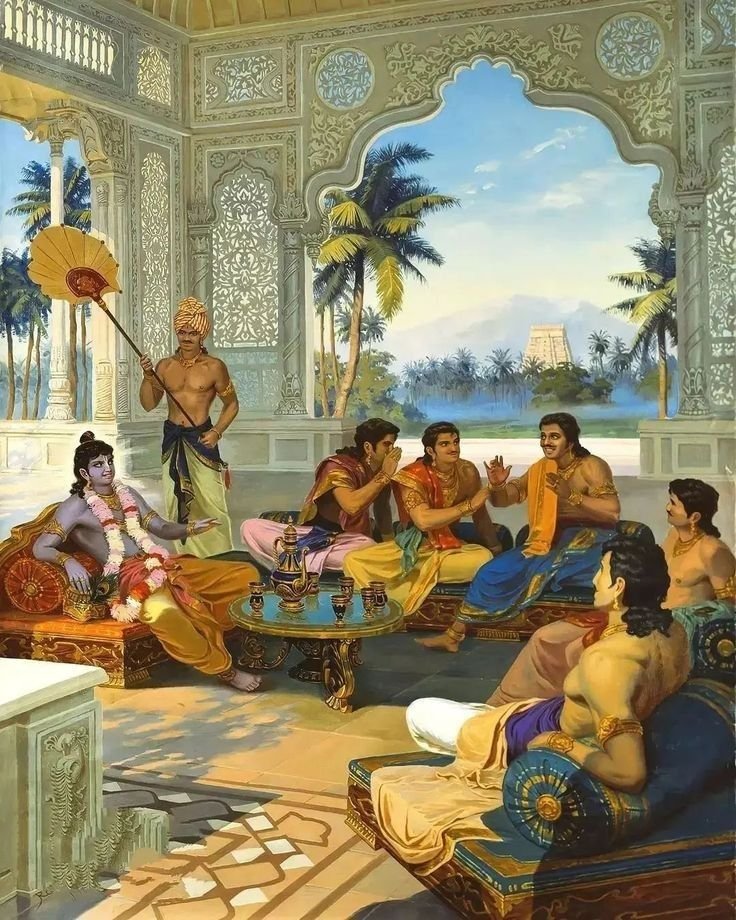
The Udyoga Parva Mahabharata describes the final diplomatic effort made before the Kurukshetra war.
This is a brilliant prompt! To frame the Udyoga Parva as the “reverse” of the Sabha Parva, especially through the sentimental lens of Krishna as the Pandavas’ messenger, allows us to explore hope, diplomacy, and the agonizing weight of impending war. It’s about the last desperate plea for peace before the inevitable storm.
Here is a detailed narrative of the Udyoga Parva, with a strong focus on Krishna’s role as messenger and the emotional undercurrents, framed as a reversal of the Sabha Parva’s despair:
The Udyoga Parva: Krishna’s Peace Mission – A Sentimental Plea, The Last Ray of Hope
If the Sabha Parva was the shattering of dharma, a descent into the abyss of humiliation and despair, then the Udyoga Parva was the desperate, yearning ascent towards a last ray of hope, a fervent prayer for the restoration of righteousness. It was the poignant reversal of fortune, where the oppressed, armed with truth and divine backing, sought not vengeance but justice, not war but peace. And at the heart of this poignant effort stood Lord Krishna, not as the silent savior, but as the eloquent, heartfelt messenger for the Pandavas.
The years of exile had been long and arduous, thirteen years that had scarred the Pandavas and Draupadi, but had also forged them into beings of unshakeable resolve. The bitter memory of the Sabha Parva – Draupadi’s disrobing, the elders’ silence, the vows of vengeance – lay dormant, yet potent, beneath the surface of their hearts. Now, the term of exile was complete. It was time for the promised restitution, for the return of their kingdom.
The Gathering Storm: Sentiments of Hope and Dread
The Udyoga Parva, meaning “The Book of Effort” or “Preparations,” begins with a flurry of activity, but it’s not merely military strategy. It’s a tapestry woven with deep human emotions: the Pandavas’ justifiable expectation of their kingdom, the Kauravas’ stubborn refusal, and the agonizing dilemma faced by all who understood the devastating cost of war.
The Pandavas, now residing in Upaplavya, a city in the Matsya kingdom, begin sending envoys. Their messages are clear: “The term of exile is over. We seek peace. We seek only our rightful share – half of the kingdom.” But beneath these formal diplomatic requests pulsed a deep vein of sentiment.
Yudhishthira, ever the embodiment of dharma, genuinely yearned for peace. His heart, though bruised, recoiled from the thought of fratricidal war. Bhima and Arjuna, however, carried the fiery embers of past insults, their sentimental connection to Draupadi’s humiliation making them restless for justice. Draupadi herself, though now composed, carried the silent, burning memory of her vow, her hair still unbound, a poignant reminder of the unavenged insult.
The Pandavas, recognizing the gravity of the situation, began to gather allies. They sought out kings and armies, not for aggression, but to lend weight to their plea for justice, to show Duryodhana that they were not weak. This was a preparation born of necessity, a heavy burden on Yudhishthira’s soul.
Krishna’s Mission: The Weight of the World on His Shoulders
Krishna’s journey was not merely political diplomacy.
It was an act of compassion and responsibility.
He knew the devastation that war would bring.
As the diplomatic efforts faltered, and Duryodhana remained unyielding, the unthinkable became the only recourse: Lord Krishna volunteered to go to Hastinapura as the Pandavas’ personal envoy for peace. This was not a king sending a minister; this was the Lord of the Universe, the Supreme Soul, humbling Himself to become a messenger, to speak for peace. His decision alone spoke volumes of the desperation of the hour and the profound love and concern he held for his devotees, the Pandavas, and for humanity.
The Udyoga Parva Mahabharata and the Last Door to Peace
Imagine Krishna’s heart as he embarked on this mission. He knew the prophecy, the inexorable march towards war. Yet, fueled by compassion, he would make the ultimate effort, leaving no stone unturned to avert the catastrophe. His sentiments were clear: to save the Kuru lineage, to protect the innocent, and to uphold dharma, even if only by demonstrating that every avenue for peace had been exhausted.
Hastinapura: A Clash of Sentiments
Krishna’s arrival in Hastinapura was met with a mixed reception. The common people, the wise elders like Bhishma, Drona, Vidura, and even the blind King Dhritarashtra, welcomed him with reverence and hope. They saw in him the embodiment of truth, the last hope for peace. They knew his heart, knew his benevolent intentions.
In the Udyoga Parva Mahabharata, Krishna becomes the messenger of peace, offering reconciliation before the inevitable war.
Duryodhana, however, saw him as an adversary, a biased partisan of the Pandavas. He tried to dissuade Krishna from meeting the Pandavas, offering him luxurious hospitality. But Krishna, with a gentle firmness, refused Duryodhana’s offer, choosing instead to stay with the wise and dharmic Vidura, a symbolic rejection of Duryodhana’s opulence and deceit. This was a deeply sentimental act, choosing the path of truth and simplicity over false grandeur.
The assembly that gathered to hear Krishna’s proposal was perhaps the most crucial ever convened. Krishna stood before them, not as a King, but as a messenger, his voice resonating with both authority and a profound sense of sorrow.
Krishna’s Eloquent Plea: A Sentimental Recounting of Injustice
Krishna’s speech was a masterpiece of diplomacy, logic, and raw sentiment. He spoke of the Pandavas’ virtues, their adherence to dharma, their immense suffering. He reminded the assembly of their rightful claim, their patience during exile. He spoke of the beauty of peace, the horror of war, and the devastating consequences that awaited if conflict erupted.
He addressed Dhritarashtra directly, appealing to the old king’s paternal affection: “O King, these Pandavas are your sons, as much as Duryodhana. Do you wish to see your lineage destroyed?” His words were not accusatory, but imbued with a deep sadness, a pleading tone that sought to awaken the dormant conscience within the blind monarch.
Then, with a heavy heart, Krishna subtly evoked the painful memory of the Sabha Parva, though without directly mentioning Draupadi’s name, knowing the shame it would bring. He spoke of “unspeakable wrongs” and “unbearable insults,” reminding them that the Pandavas, despite their power, were still seeking reconciliation. He highlighted that the Pandavas were asking only for their due – not a single blade of grass beyond what was promised.
“Give them five villages,” Krishna implored, his voice imbued with a poignant mixture of hope and resignation. “Just five villages, one for each brother, so they might live in peace. Let there be no war.”
Krishna spoke to the court.
He reminded them of justice.
The messenger of peace warned them about war.
Finally, he urged reconciliation.
This offer of “five villages” was the sentimental reverse of the Sabha Parva. In that hall, Draupadi had been stripped of everything, her dignity assaulted. Now, Krishna, on behalf of the Pandavas, was asking for the absolute minimum, a gesture so small, yet so loaded with the desire for peace, that only the most hardened heart could refuse. It was a plea for a fraction of what was lost, an echo of the dignity that had been so cruelly taken away. It was a sentimental compromise, a final olive branch offered from hearts that had endured unimaginable pain.
The Unyielding Heart: Sentiment Rejected
But Duryodhana, blinded by ego and hatred, rose to reject Krishna’s plea. His response was cold, unyielding, devoid of any empathy. “I shall not give the Pandavas even land enough to stick a needle in!” he declared. His words were a brutal slap in the face of sentiment, peace, and dharma itself.
Krishna, witnessing this hardened resolve, felt a deep sorrow. He had exhausted every avenue. He had humbled himself, appealed to reason, compassion, and self-preservation. Yet, Duryodhana remained unmoved. The inevitable, which Krishna had known in his divine wisdom, now became a chilling certainty for all.
Duryodhana Rejects the Peace Proposal
In a dramatic moment, Duryodhana even attempted to seize Krishna, to hold him captive. But Krishna, in his divine form (Vishwaroopa), revealed his cosmic majesty, stunning the assembly and displaying the futility of Duryodhana’s arrogance. Yet, even this awe-inspiring display of power was part of Krishna’s sorrowful plan, a final, undeniable proof that he had offered every chance for peace, that the Kauravas had chosen their own doom.
The Return: A Heavy Heart and the Dawn of War
Krishna returned to the Pandava camp, his heart heavy. The silence in the camp as he narrated the outcome was deafening. The last fragile thread of hope had been severed. Draupadi, hearing of Duryodhana’s unwavering refusal, now faced the bitter truth: her vow would be fulfilled, but at an immeasurable cost. The sentimental plea for peace had failed, and now only the path of absolute justice, through war, remained.
The Udyoga Parva, therefore, is the tragic book of last efforts. It is sentimental because it explores the deep human longing for reconciliation, the agony of choosing war, and the profound sadness of a divine being whose compassion for humanity compels him to try and avert a catastrophe he knows is coming.
It is the reverse of the Sabha Parva because where despair had swallowed dignity, here, dignity makes a desperate, valiant stand for peace, only to be crushed by obstinacy, leading to the thunderous preparations for the ultimate battle of Kurukshetra. The tears shed in the Sabha Parva were of shame and betrayal; the tears un-shed but felt deeply in the Udyoga Parva were for a peace that could have been, for a world teetering on the brink of self-destruction.
The lesson of the Udyoga Parva Mahabharata is clear: peace must always be attempted before war becomes unavoidable.
For detailed story of this Parva please click here https://www.sacred-texts.com/hin/m02/m02000.htm
- Series Articles Readers may follow the series to understand how the epic moves from moral collapse to diplomacy, war, and finally wisdom.
-
Mahabharata 18 Parvas – Structure of the Epic https://lifedevote.com/the-mahabharat-18-parvas/
-
Sabha Parva – When Silence Became Sin https://lifedevote.com/when-silence-became-sin/
-
Udyoga Parva – The Last Door to Peace https://lifedevote.com/udyoga-parva-mahabharata-krishnas-peace-mission/
-
4. Shanti Parva – The Silence That Teache https://lifedevote.com/shanti-parva-mahabharata/
