


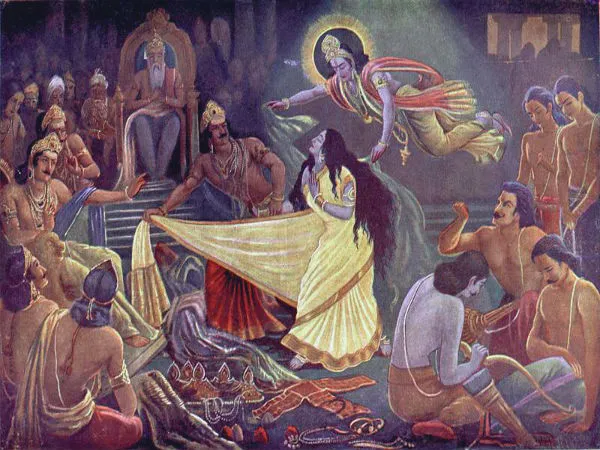
Draupadi’s Cry for Dharma in the Sabha Parva
Introduction
Among the countless episodes of the Mahabharata, few scenes possess the emotional intensity and moral gravity of Draupadi’s humiliation in the Sabha Parva. This moment is not merely a tragic incident within the narrative; it is the moral turning point of the entire epic.
In that royal assembly hall, the foundations of dharma were shaken. Kings, elders, and warriors sat silently while injustice unfolded before their eyes. The humiliation of Draupadi revealed not only the cruelty of the perpetrators but also the devastating consequences of silence in the face of wrongdoing.
The Sabha Parva therefore stands as one of the most powerful reflections on power, dignity, and moral responsibility in world literature.
The Dice Game — The Beginning of Moral Collapse
The story begins with the flourishing kingdom of Indraprastha, the magnificent city established by the Pandavas. Its extraordinary palace, designed by the celestial architect Maya, was filled with wonders and illusions.
Yet this prosperity ignited jealousy in the heart of Duryodhana.
Unable to bear the success of the Pandavas, he conspired with his uncle Shakuni, a master of deceitful dice. A royal invitation was sent to Yudhishthira to participate in a game of dice in the Kuru court.
For a Kshatriya king, refusing such an invitation was considered dishonorable. Bound by this rigid code of conduct, Yudhishthira accepted the challenge, unaware that the game was carefully designed as a trap.
One by one he gambled away his wealth, his kingdom, his brothers, and finally himself.
But the final and most tragic wager was yet to come.
The Fatal Wager — Draupadi Staked in the Game
After losing himself, Yudhishthira placed Draupadi, the queen of the Pandavas, as the final stake.
This act created one of the most profound moral dilemmas in the epic. If a man had already lost his own freedom, could he still claim authority over another person?
This question would soon echo through the royal court.
Duryodhana, intoxicated by victory, ordered that Draupadi be brought to the assembly hall as a slave.
Draupadi’s Question — The Voice of Dharma
When the messenger Pratikamin arrived to summon her, Draupadi refused to appear immediately. Her response was not anger but a sharp and penetrating question:
“Did the king lose himself first, or did he lose me first?”
Her inquiry struck at the very heart of the situation. If Yudhishthira had already lost himself, then he no longer possessed the authority to wager her.
Thus Draupadi transformed a personal humiliation into a philosophical question of law, ethics, and dharma.
Yet the court remained silent.
Dragged into the Assembly
Duryodhana’s patience quickly turned to cruelty.
He commanded his brother Dushasana to bring Draupadi by force.
What followed remains one of the most painful scenes in the entire Mahabharata. Dushasana seized Draupadi by her hair — a sacred symbol of a woman’s dignity — and dragged her into the royal assembly.
Before her stood the greatest figures of the Kuru dynasty:
- Bhishma
- Drona
- Kripacharya
- Dhritarashtra
- the assembled kings and warriors
Yet none of them intervened.
The silence of the assembly became more terrible than the violence itself.
Draupadi’s Appeal to the Elders
However, Draupadi raised her voice in the assembly.
Standing before the court, humiliated yet fearless, Draupadi raised her voice. Yet, the court remained silent.
She did not beg for mercy. Instead she demanded justice.
Her words were a direct challenge to the conscience of the elders:
“How can a woman be treated as property? If my husband has already lost himself, what right did he have to wager me?”
Her questions echoed through the hall, exposing the moral paralysis of those who should have defended righteousness.
Even the mighty warriors remained motionless.
When Silence Becomes Complicity
The Sabha Parva reveals a profound truth about ethical responsibility.
Injustice does not triumph merely because of the wicked actions of the powerful. It also triumphs when the righteous remain silent.
Bhishma himself admitted that dharma is subtle and difficult to interpret, yet his inability to act allowed the injustice to continue.
Thus the tragedy of the Sabha Parva lies not only in Draupadi’s suffering but also in the failure of moral courage among those present.

The Attempt to Disrobe Draupadi
Duryodhana, driven by arrogance, ordered Dushasana to disrobe Draupadi in the assembly hall.
In that moment Draupadi realized that no human power in the hall would defend her.
Her husbands sat bound by the rules of the game. The elders remained silent. Justice seemed absent.
At the edge of despair, she turned toward the one refuge that remained.
Draupadi’s Surrender to the Divine
Closing her eyes, Draupadi raised her hands in prayer and called upon Krishna:
“O Govinda, protector of the helpless, I surrender to you. Save my honor.”
This moment marks the spiritual climax of the episode. Stripped of worldly support, Draupadi placed her complete trust in the divine.
And the miracle occurred.
As Dushasana pulled at her garment, the cloth continued to extend endlessly. No matter how much he pulled, more fabric appeared.
Exhausted and defeated, Dushasana collapsed.
Draupadi’s dignity was preserved by divine grace. Ultimately, Krishna protected her honor.
The Vow That Changed History
Though saved from dishonor, the humiliation left a deep scar.
Draupadi took a solemn vow:
She would not tie her hair again until it had been washed with the blood of Dushasana.
This vow transformed her suffering into a powerful call for justice.
The seeds of the Kurukshetra War were now firmly planted.
Draupadi as a Symbol of Dharma
Draupadi’s ordeal is not merely a story of victimhood.
She emerges as one of the most powerful moral voices in the Mahabharata. Her courage, intellect, and devotion challenge the entire assembly and expose the fragile nature of justice when power dominates conscience.
Through her questions, the epic asks every generation a difficult question:
What happens to dharma when those who know the truth remain silent?
Meditation Reflection Box
Draupadi’s Strength and Surrender
Take a moment of quiet reflection.
Imagine the assembly hall — filled with powerful figures, yet dominated by silence.
Observe Draupadi standing alone, questioning injustice.
Reflect on three lessons from this moment:
• The courage to speak truth even when no one listens.
• The resilience of the human spirit in the face of humiliation.
• The power of surrender when human support fails.
Draupadi’s story reminds us that dignity may be attacked, but inner strength cannot be conquered.
Conclusion
The Moral Turning Point of the Mahabharata
The Sabha Parva represents the moment when the moral order of the Kuru dynasty collapsed.
The humiliation of Draupadi shattered the illusion of harmony within the royal court and exposed the deep corruption of power.
From that day onward, reconciliation became impossible. The war of Kurukshetra was no longer a political conflict; it became a struggle for the restoration of dharma.
Draupadi’s voice continues to echo across centuries, reminding humanity that silence in the presence of injustice is itself a form of injustice.
- Series Articles Readers may follow the series to understand how the epic moves from moral collapse to diplomacy, war, and finally wisdom.
Please visit 18 parvas detail click here https://lifedevote.com/the-mahabharat-18-parvas/
