



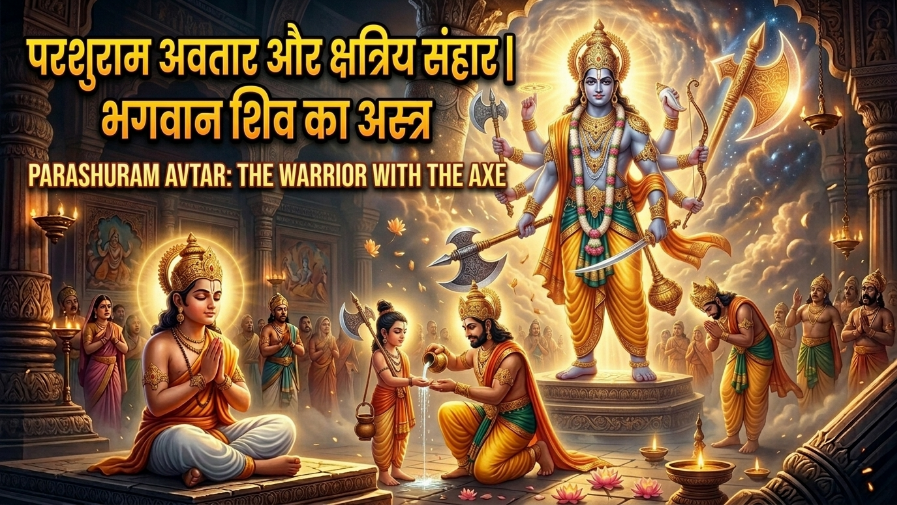
Introduction: The Fierce Turning Point in Dashavatara
The journey of the Dashavatara is not just a sequence of divine incarnations—it is a symbolic evolution of life, consciousness, and moral order. From the preservation seen in Matsya, the stability of Kurma, the rescue by Varaha, the protection of Narasimha, and the humility of Vamana, the path now reaches a powerful turning point in the form of Parashurama Avatar.
This is where divine energy takes a fierce and corrective form. Unlike earlier avatars that guided or protected, Parashurama represents action—decisive, intense, and necessary. It is the moment when dharma is not just defended but actively restored.
⚔️ Who is Parashurama Avatar? The Warrior Sage
Parashurama Avatar is the sixth incarnation of Lord Vishnu, born as the son of sage Jamadagni and Renuka. His name literally means “Rama with an axe,” symbolizing his unique identity as both a Brahmin (man of knowledge) and a warrior (man of action).
This dual nature makes Parashurama one of the most complex and fascinating avatars. He is not just a destroyer of evil but a restorer of balance. Armed with a divine axe gifted by Lord Shiva, Parashurama becomes the force that challenges the growing corruption among powerful rulers.
Unlike kings who ruled with ego, Parashurama stood for discipline, truth, and justice. His life is a reminder that knowledge without strength is incomplete—and strength without wisdom is dangerous.
The story of Parashurama, known as the Parashurama Avatar, represents justice and correction of imbalance. This video explains how divine power restores dharma.
👉Watch the video below to understand the deeper meaning of Parashurama Avatar.
Parashurama Avatar teaches discipline and righteous action. Continue with Matsya, Kurma, Varaha, Narasimha, Vamana, Rama, Krishna, Buddha, and Kalki.
📖 The Story of Parashurama Avatar
The story of Parashurama Avatar is deeply rooted in ancient texts like the Mahabharata and various Puranas.
King Kartavirya Arjuna, a powerful ruler, became arrogant due to his immense strength and authority. One day, he visited the ashram of sage Jamadagni, where he was treated with great respect. However, blinded by ego, the king later returned and killed the sage to seize the divine cow Kamadhenu.
This act of injustice shook the balance of dharma.
In response, Parashurama took a vow of vengeance—not out of personal anger, but to restore righteousness. He defeated Kartavirya Arjuna and is said to have rid the earth of corrupt Kshatriya rulers twenty-one times.
While this may seem harsh, it symbolizes the removal of arrogance and misuse of power. It is not just a physical battle but a deeper cleansing of societal imbalance.
🔥 Symbolism of Parashurama Avatar

The Parashurama Avatar carries profound symbolic meaning beyond its dramatic narrative.
Parashurama represents the cycle of correction in the universe. When power becomes corrupt, nature—and divinity—intervenes to restore balance. His axe is not merely a weapon; it is a symbol of cutting away ego, injustice, and ignorance.
This avatar also represents the fusion of two essential forces:
- Knowledge (Brahmin energy)
- Power (Kshatriya energy)
In today’s world, this teaches us that true leadership requires both wisdom and strength. Without this balance, society either becomes weak or oppressive.
🌍 Connection with Other Avatars in Dashavatara
The beauty of the Dashavatara lies in its continuity. Each avatar prepares the ground for the next.
Parashurama acts as a bridge between:
- The spiritual humility of Vamana
- The ideal kingship of Rama
While Vamana taught humility, Parashurama enforces discipline. He clears the path for a world where righteousness can flourish again under Rama.
Interestingly, Parashurama also appears in the Ramayana, where he encounters Lord Rama, symbolizing the transition from one era of dharma to another.
🛕 Famous Temples of Parashurama in India


Across India, several temples are dedicated to Parashurama Avatar, reflecting his deep cultural and spiritual significance.
One of the most famous is the Thiruvallam Parashurama Temple in Kerala, believed to be established by Parashurama himself. It is closely associated with rituals for ancestors and spiritual purification.
Another important site is the Renuka Devi Temple in Himachal Pradesh, dedicated to his mother, highlighting the emotional and human aspect of his story.
The Parashurama Temple in Chiplun, Maharashtra, is also widely visited, while Parashurama Kund in Arunachal Pradesh is a sacred pilgrimage site where devotees seek purification.
These temples not only preserve history but also keep alive the deeper message of balance and righteousness.
🧠 Life Lessons from Parashurama Avatar
The story of Parashurama Avatar offers powerful lessons for modern life.
First, it teaches that power must always be guided by ethics. Without moral direction, even strength becomes destructive.
Second, it shows that anger, when aligned with justice, can become a force for transformation. Parashurama’s actions were not driven by ego but by a commitment to dharma.
Third, it reminds us that correction is a natural part of growth. Just as nature restores balance, individuals and societies must also confront and correct their imbalances.
Finally, it emphasizes discipline and self-control as the foundation of true strength.
✨ Conclusion: The Avatar of Necessary Transformation
Parashurama Avatar stands as one of the most intense and thought-provoking incarnations of Lord Vishnu. It is not merely a story of destruction but a profound lesson in renewal.
In the grand journey of the Dashavatara, Parashurama represents the moment when the universe corrects itself—when imbalance is no longer tolerated, and transformation becomes inevitable.
As we move forward to the story of Rama, we see how this очищение (purification) leads to the establishment of ideal righteousness.
Parashurama teaches us that sometimes, to rebuild a better world, we must first have the courage to remove what is unjust.
🔍 FAQ Schema (For Ranking Boost)
Q1. Who is Parashurama Avatar?
Parashurama Avatar is the sixth incarnation of Lord Vishnu, known as a warrior sage who restored dharma by eliminating corrupt rulers.
Q2. Why did Parashurama destroy Kshatriyas?
He acted to remove injustice and arrogance when rulers misused their power and disturbed the balance of dharma.
Q3. What does Parashurama symbolize?
He symbolizes the balance of knowledge and power, and the need for correction when injustice rises.
Q4. Is Parashurama still alive?
According to Hindu belief, Parashurama is a Chiranjivi (immortal) and continues to exist.
Explore Detailed Vishnu Avatars
To understand the deeper meaning, stories, Stotra and symbolism of each incarnation, explore the detailed articles on the 10 avatars of Vishnu below. Each post explains the philosophy, scientific insight, and spiritual significance of the Dashavatara in depth.
- 👉 Matsya Aawtaar –
👉 Kurm Aawtaar
👉 Varah Aawtaar
👉 Narsimgh Avtaar - 👉Vamana
- 👉 Ram Avtaar
- 👉 Krishna Awtaar
- 👉 Budha Avtaar
- 👉 Kalki Avtaar
- 👉 Dashavtaar stotra
