



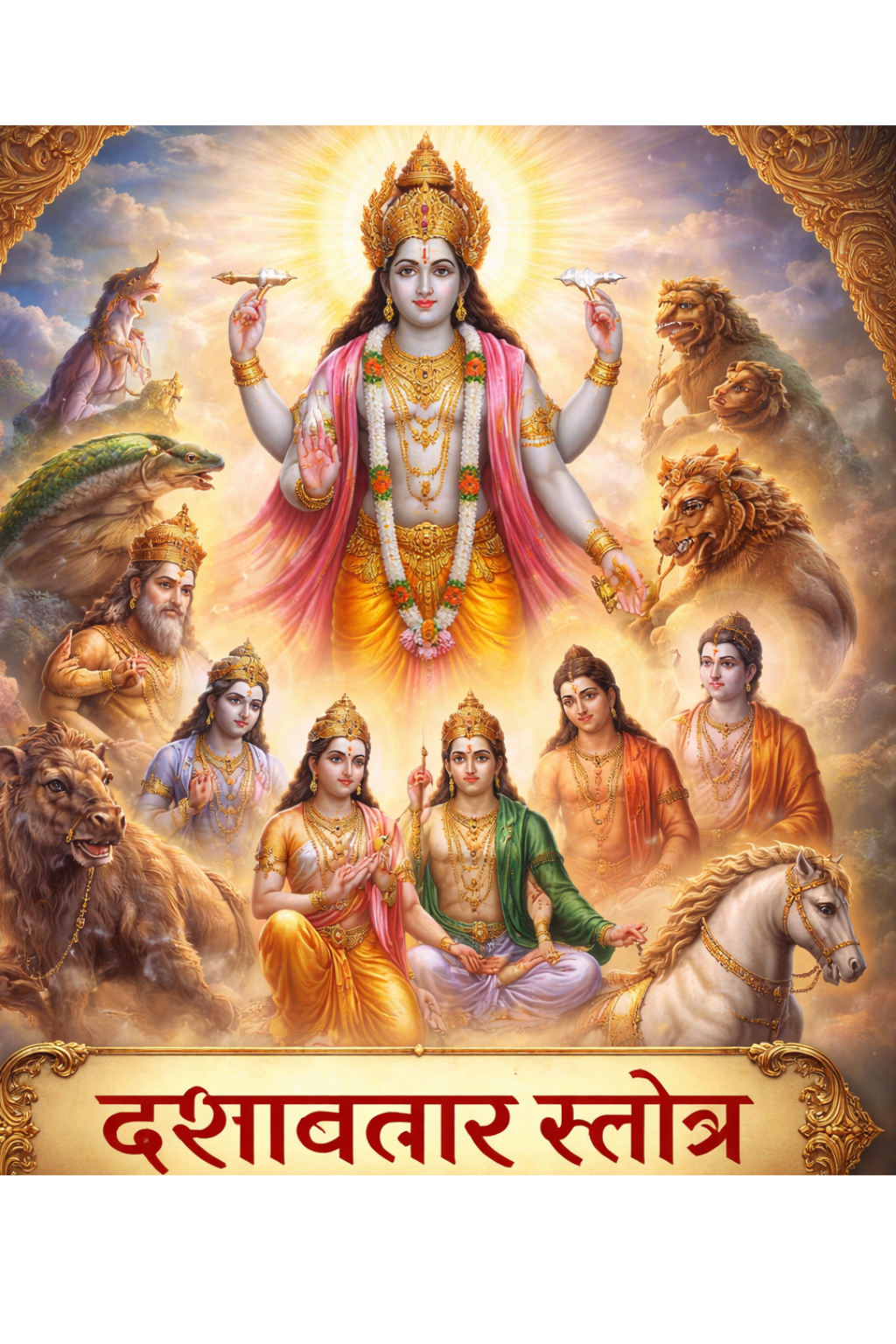
Introduction: The Divine Hymn of the 10 Avatars
What is Dashavatara Stotra?
The Dashavatara Stotra is a beautiful and powerful hymn composed by Jayadeva in his famous work Gita Govinda. This sacred composition praises the ten incarnations of Vishnu and their role in restoring Dharma and cosmic balance., capturing their divine actions in poetic form.
Each verse of this stotra is not just devotional—it is a symbolic expression of how Vishnu restores balance, protects knowledge, and guides the universe through different stages of existence.
Dashavatara Stotra at a Glance
- Written by: Jayadeva
- Source: Gita Govinda
- Language: Sanskrit
- Theme: 10 avatars of Vishnu
- Purpose: Praise and understanding of divine incarnations
What are the 10 Avatars in Dashavatara Stotra?
The ten avatars described in the Dashavatara Stotra are:
- Matsya
- Kurma
- Varaha
- Narasimha
- Vamana
- Parashurama
- Rama
- Balarama (or Krishna in some traditions)
- Buddha
- Kalki
Dashavatara Stotra (Sanskrit Text with Hindi Meaning)
Below is the original stotra along with its Hindi explanation:
1. Matsya Aawtaar 
प्रलय पयोधि-जले धृतवान् असि वेदम्
विहित वहित्र-चरित्रम् अखेदम्
केशव धृत-मीन-शरीर, जय जगदीश हरे
👉 अर्थ: प्रलय के समय भगवान ने मछली का रूप धारण कर वेदों की रक्षा की और जीवन को सुरक्षित रखा।
2. Kurm Aawtaar 
क्षितिर् इह विपुलतरे तिष्ठति तव पृष्ठे
धरणि-धारण-किण चक्र-गरिष्ठे
केशव धृत-कूर्म-शरीर जय जगदीश हरे
👉 अर्थ: भगवान ने कच्छप रूप में मंदराचल पर्वत को अपनी पीठ पर धारण कर समुद्र मंथन को संभव बनाया।
3. Varah Aawtaar 
वसति दशन शिखरे धरणी तव लग्ना
शशिनि कलंक कलेव निमग्ना
केशव धृत शूकर रूप जय जगदीश हरे
👉 अर्थ: वराह रूप में भगवान ने पृथ्वी को समुद्र से उठाकर पुनः स्थापित किया।
4. Narasimha Aawtaar 
तव कर-कमल-वरे नखम् अद्भुत शृंगम्
दलित-हिरण्यकशिपु-तनु-भृंगम्
केशव धृत-नरहरि रूप जय जगदीश हरे
👉 अर्थ: नरसिंह रूप में भगवान ने भक्त प्रह्लाद की रक्षा करते हुए हिरण्यकशिपु का वध किया।
5. Vaman Aawtaar 
छलयसि विक्रमणे बलिम् अद्भुत-वामन
पद-नख-नीर-जनित-जन-पावन
केशव धृत-वामन रूप जय जगदीश हरे
👉 अर्थ: वामन रूप में भगवान ने तीन पगों में ब्रह्मांड को नापकर राजा बलि का अहंकार समाप्त किया।
6. Parashuram Aawtaar 
क्षत्रिय-रुधिरा-मे जगद-अपगत-पापम्
स्नैपायसी पयसि समिता-भाव-त
केशव धृत-परशुराम रूप जय जगदीश हरे
👉 अर्थ: परशुराम रूप में भगवान ने अधर्म का नाश कर पृथ्वी को पापों से मुक्त किया।
7. Ram Aawtaar 
वितरसि दिक्षु रणे दिक्-पति-कमनीयम्
दश-मुख-मौलि-बलिम् रमणीयम्
केशव धृत-राम-शरीर जय जगदीश हरे
👉 अर्थ: राम रूप में भगवान ने रावण का वध कर धर्म की स्थापना की।
8. Krishna-Balaram Aawtaar 
वहसि वपुशि विसदे वसनम् जलदाभम्
हल-हति-भीति-मिलित-यमुनाभम्
केशव धृत-हलधर रूप जय जगदीश हरे
👉 अर्थ: बलराम रूप में भगवान ने हल धारण कर अधर्म का नाश किया और यमुना को नियंत्रित किया।
9. Buddha Aawtaar
निंदसि यज्ञ-विधेर् अहः श्रुति-जातम्
सदय-हृदय-दर्शित-पशु-घातम्
केशव धृत-बुद्ध-शरीर जय जगदीश हरे
👉 अर्थ: बुद्ध रूप में भगवान ने करुणा का संदेश दिया और हिंसा का विरोध किया।
10. Kalki Aawtaar

म्लेच्छ-निवह-निधने कलयसि करवालम्
धूमकेतुम् इव किम् अपि करालम्
केशव धृत-कल्कि-शरीर जय जगदीश हरे
👉 अर्थ: कल्कि रूप में भगवान कलियुग के अंत में अधर्म का नाश करेंगे।
Deeper Meaning of Dashavatara Stotra
This stotra beautifully compresses the entire journey of the Dashavatara into poetic form. Each verse represents a stage of evolution, consciousness, and restoration of Dharma.
It shows that divine intervention is continuous and adapts according to the needs of time.
Spiritual Significance of Dashavatara Stotra
The Dashavatara Stotra is not merely a poetic composition—it is a profound spiritual map that reflects the eternal relationship between the divine and the universe. Each verse represents a moment when Vishnu intervenes to restore balance and protect Dharma.
The hymn teaches that divine presence is not static but dynamic, constantly adapting to the needs of time. From preserving knowledge in the Matsya Aawtaar to establishing righteousness in Rama and guiding consciousness through Krishna, the stotra captures the essence of divine evolution.
It also emphasizes that spiritual growth follows a journey—from survival to awareness, and from awareness to enlightenment. Thus, the Dashavatara Stotra becomes not just a prayer, but a reflection of life itself.
Philosophical Meaning of the Dashavatara Stotra
The Dashavatara Stotra beautifully compresses deep philosophical truths into poetic verses. Each avatar represents a stage in the evolution of both the universe and human consciousness.
The early avatars such as Matsya, Kurm, and Varah symbolize the emergence of life and stability in nature. Narasimha represents the breaking of boundaries, showing that truth exists beyond logic. Vaman reflects expansion of consciousness, while Parashuram symbolizes correction of imbalance.
Later avatars like Rama and Krishna represent the refinement of human values, ethics, and wisdom. The inclusion of Gautama Buddha highlights compassion and inner awakening, while Kalki points toward transformation and renewal.
Thus, the stotra is not just devotional—it is philosophical, scientific, and symbolic.
Benefits of Reciting Dashavatara Stotra
Reciting the Dashavatara Stotra is believed to bring both spiritual and mental benefits. It helps the devotee connect with the divine qualities of Vishnu and align with the principles of Dharma.
Key Benefits:
- Promotes inner peace and mental clarity
- Strengthens faith and devotion
- Enhances understanding of life’s purpose
- Encourages balance between action and wisdom
- Inspires transformation and self-growth
Regular recitation also creates a sense of discipline and harmony, helping individuals navigate challenges with a calm and focused mind.
When and How to Recite Dashavatara Stotra
The Dashavatara Stotra can be recited during daily prayers, especially in the morning or evening. It is also commonly chanted during Vishnu-related festivals and Ekadashi.
To recite effectively:
- Sit in a शांत (calm) place
- Focus on meaning, not just words
- Recite with devotion and awareness
Even listening to the stotra can create a deep sense of spiritual connection.
Connection with the 10 Avatars of Vishnu
The Dashavatara Stotra is directly connected to the broader concept of the 10 avatars of Vishnu. While the pillar post explains each avatar in detail, this stotra presents them in a condensed poetic form.
👉 Explore full explanation here:
10 Avatars of Vishnu Explained (Dashavatara)
What You Have Learned from Dashavatara Stotra
This stotra teaches that the 10 avatars of Vishnu are not just stories but expressions of divine balance, compassion, and transformation. It reflects the journey of life from survival to higher consciousness.
Frequently Asked Questions
What is Dashavatara Stotra?
Dashavatara Stotra is a Sanskrit hymn by Jayadeva describing the ten incarnations of Vishnu and their role in maintaining cosmic balance.
Who wrote Dashavatara Stotra?
Dashavatara Stotra was written by Jayadeva, a famous Sanskrit poet and devotee of Vishnu.
Why is Dashavatara Stotra important?
It explains the significance of Vishnu’s avatars and highlights the principles of Dharma, protection, and transformation.
It praises Vishnu’s incarnations and explains their role in restoring cosmic balance.
Explore Detailed Vishnu Avatars
To understand the deeper meaning, stories, Stotra and symbolism of each incarnation, explore the detailed articles on the 10 avatars of Vishnu below. Each post explains the philosophy, scientific insight, and spiritual significance of the Dashavatara in depth.
- 👉 Matsya Aawtaar –
👉 Kurm Aawtaar
👉 Varah Aawtaar
👉 Narasimha Aawtaar
👉 Vaman Aawtaar
👉 Parashuram Aawtaar - 👉 Ram Avtaar
- 👉 Krishna Awtaar
- 👉 Budha Avtaar
- 👉 Kalki Avtaar
- 👉 10 Avatars of Vishnu Explained (Dashavatara)
