



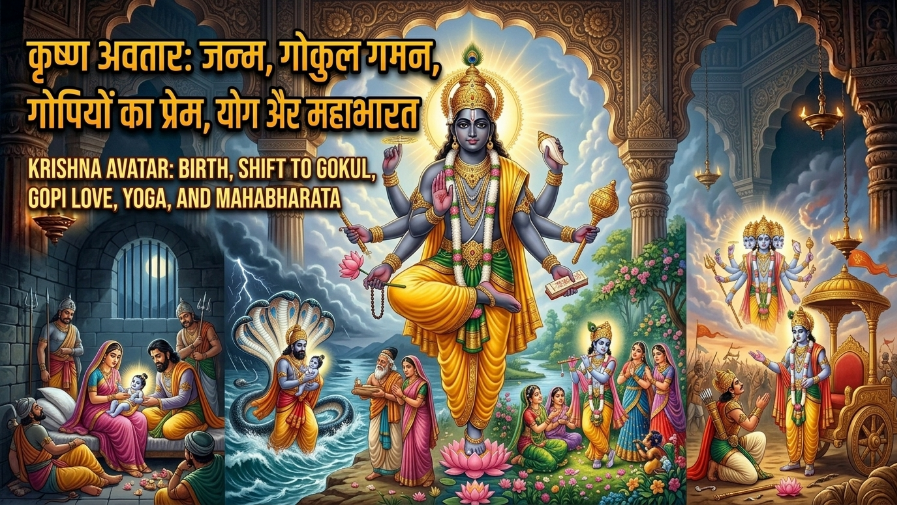
Intrtoduction-Krishna Avatar
The journey of the Dashavatara evolves from survival and protection to the perfection of human life in Rama, and finally reaches its highest intellectual and spiritual expression in the form of Krishna. Unlike previous avatars that focused on establishing order, Krishna Avatar reveals the deeper wisdom behind life itself. Through his teachings in the Bhagavad Gita, Krishna shows how to act without attachment, how to balance duty with awareness, and how to understand the true nature of existence. This avatar represents not just dharma in action, but dharma understood at its deepest level.
The journey of the Dashavatara reflects the gradual evolution of life—from survival and protection to the perfection of human character in Rama. This progression reaches its highest intellectual and spiritual expression in the form of Krishna, known as the Krishna Avatar
Unlike earlier avatars that established order through action, Krishna reveals the deeper wisdom behind life itself. His presence transforms dharma from a rule to a realization.
Krishna is not just an incarnation; he is a complete philosophy of life—where action, love, wisdom, and play coexist in perfect harmony. If Rama shows how to live ideally, Krishna reveals how to understand life itself.
The story of Krishna, known as the Krishna Avatar, represents divine wisdom, love, and strategy. This video explains the teachings of Krishna and the deeper meaning of life.
▶ Watch the video below to understand the deeper meaning of Krishna Avatar.
Krishna Avatar teaches wisdom and detachment. Continue exploring Matsya Aawtaar –, Kurm Aawtaar, Varah Aawtaar Narsimgh Avtaar Vamana, Parshuram Avtaar Ram Avtaar, Buddha, and Kalki.
Krishna is one of the most beloved and multidimensional incarnations of Lord Vishnu. He is not just a king or warrior but a teacher, friend, philosopher, and guide.
From his playful childhood in Vrindavan to his strategic brilliance in the Mahabharata, Krishna embodies the full spectrum of human experience. He shows that life is not to be escaped but understood and lived consciously.
What Krishna Avatar Express? The Complete Expression of Life
Krishna, the eighth incarnation of Lord Vishnu, is the most dynamic and human-like divine presence. He is a child full of joy, a lover full of devotion, a strategist full of intelligence, and a guru full of wisdom.
Unlike other avatars, Krishna does not follow a single role—he embraces all aspects of existence. He shows that spirituality is not about renouncing life but living it fully with awareness.
Prem Yog: The Divine Love of Radha and Gopis

One of the most beautiful and profound aspects of Krishna Avatar is Prem Yog—the path of divine love.
In Vrindavan, Krishna’s relationship with Radha and the Gopis is not ordinary romance; it is a symbol of soul’s longing for the divine. Radha represents pure devotion, where love is unconditional, selfless, and beyond ego.
The Raas Leela, where Krishna dances with every Gopi simultaneously, symbolizes that the divine is present in every heart. Each soul feels a personal connection with the infinite.
Prem Yog teaches that:
- Love is not possession, but surrender
- True devotion dissolves ego
- The highest spiritual state is union through love
Krishna’s flute becomes a metaphor—it calls the soul back to its source. Those who hear it (like the Gopis) leave everything behind, symbolizing the pull of divine consciousness.
Bhakti Yog: The Path of Devotion

Beyond love, Krishna Avatar reveals Bhakti Yog, the path of surrender and devotion.
In Bhakti, the individual does not try to control life but offers everything to the divine. Krishna teaches that when actions are performed with devotion, they become sacred.
The devotion of Meera, the loyalty of Sudama, and the surrender of Arjuna all reflect this path. Bhakti Yog transforms ordinary life into spiritual practice.
Krishna shows that:
- Devotion brings inner peace
- Surrender removes fear and anxiety
- God is not distant but present in every moment
Bhakti Yog is simple yet powerful—it does not require knowledge or strength, only a pure heart.
Gyan Yog: The Wisdom of Bhagavad Gita
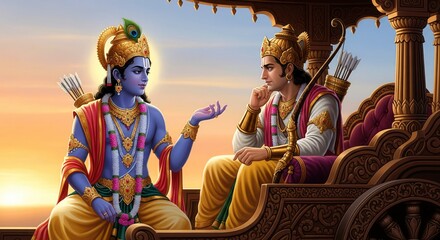
While love and devotion form one aspect, Krishna Avatar also reveals the highest knowledge through Gyan Yog.
In the battlefield of Kurukshetra, described in the Mahabharata, Krishna delivers the teachings of the Bhagavad Gita to Arjuna.
Here, Krishna explains:
- The nature of the self (Atman)
- The illusion of attachment
- The importance of duty (dharma)
He teaches that the soul is eternal, beyond birth and death. Fear arises from ignorance, and freedom comes from understanding reality.
Gyan Yog shows that:
- Knowledge removes confusion
- Awareness leads to liberation
- Truth is experienced, not just learned
Karma Yog: Action Without Attachment
Krishna’s most practical teaching is Karma Yog—the art of action.
He advises Arjuna to act without attachment to results. This does not mean indifference, but freedom from anxiety about outcomes.
Karma Yog teaches:
- Focus on action, not results
- Do your duty with full awareness
- Success and failure are temporary
This teaching is highly relevant today, where stress and expectations dominate life.
Connection of Krishna Avatar with Other Avatars in Dashavatara
In the flow of the Dashavatara, Krishna Avatar represents the peak of understanding.
If Vamana teaches humility, Parashurama enforces discipline, and Rama establishes ideal conduct, then Krishna explains the inner meaning of all these principles.
This prepares the transition toward Buddha, where silence and awareness become central.
Famous Temples of Lord Krishna in India


Temples dedicated to Krishna Avatar are among the most visited in India.
The Krishna Janmabhoomi Temple in Mathura marks his birthplace. The Dwarkadhish Temple in Gujarat represents his royal life. The Banke Bihari Temple in Vrindavan reflects his playful and loving nature, while the Jagannath Temple in Puri connects him with universal devotion.
Symbolism of Krishna Avatar: Life as a Divine Play
Krishna Avatar carries deep symbolic meaning.
His flute represents harmony and attraction toward truth. His playful nature shows that life is not merely serious struggle but also a divine play. His role in war demonstrates that spirituality is not separate from action—it must guide action.
Krishna teaches that balance is the key—between action and detachment, love and wisdom, duty and freedom
Life Lessons from Krishna Avatar
Krishna Avatar offers timeless guidance.
It teaches that action is necessary, but attachment is optional. It shows that confusion is natural, but clarity comes through wisdom. It emphasizes that life must be lived fully, yet consciously.
Above all, Krishna teaches that true freedom comes from understanding oneself.
Conclusion: The Ultimate Guide to Life
Krishna Avatar is not just a story—it is a complete philosophy of life. As the eighth incarnation of Lord Vishnu, Krishna transforms dharma into wisdom and action into realization.
In the journey of the Dashavatara, Krishna represents the peak of understanding before the inward silence of Buddha.
What we have learned from Krishna Avtaar
The essence of Krishna lies not merely in divine stories but in a complete understanding of life itself. Krishna teaches that life is not a burden to be carried, but a divine play (Leela) to be lived with awareness and joy. Through the wisdom of the Bhagavad Gita, he reveals that one must act fully in the world while remaining unattached to outcomes, finding freedom within action rather than escape from it. His divine love with Radha and the Gopis reflects the highest form of devotion—where love is pure, selfless, and beyond possession. At the same time, Krishna shows that true strength lies in surrender, clarity arises from awareness, and balance is the highest intelligence. Ultimately, his message transcends time: live fully, love deeply, act wisely, and remain inwardly free—because beyond all roles and circumstances, the true self is eternal, untouched, and complete.
FAQ
Q1. Who is Krishna Avatar and why is he considered the most complete incarnation?
Krishna is considered the most complete incarnation because he embodies all aspects of life—love, wisdom, action, and strategy. Unlike other avatars who focus on specific purposes, Krishna integrates playfulness, devotion, and deep philosophical insight, making his life a complete guide to human existence.
Q2. What is the deeper meaning of Krishna’s life beyond mythology?
Krishna’s life represents the journey from ignorance to awareness. His childhood symbolizes joy and innocence, his youth represents divine love, and his role in guiding humanity reflects wisdom. Together, these stages show that life is not separate from spirituality—it is the path itself.
Q3.What is Prem Yog in Krishna’s teachings?
Prem Yog is the path of divine love, best illustrated through Krishna’s relationship with Radha and the Gopis. It teaches that true love is unconditional, ego-free, and rooted in surrender rather than possession. It symbolizes the soul’s longing to unite with the divine.
Q4. How does Krishna explain Karma Yog in the Bhagavad Gita?
In the Bhagavad Gita, Krishna explains Karma Yog as performing one’s duty without attachment to results. This teaching emphasizes focusing on action with full awareness while remaining free from anxiety about outcomes, leading to inner peace and clarity.
Q5 What is Bhakti Yog and how does Krishna define devotion?
Bhakti Yog is the path of devotion where one surrenders completely to the divine. Krishna defines true devotion as pure love and trust, where the individual offers all actions and emotions to God, resulting in freedom from fear and ego.
Q6. What is Gyan Yog and how does it lead to self-realization?
Gyan Yog is the path of knowledge through which one understands the true nature of the self. Krishna teaches that the soul (Atman) is eternal and beyond physical existence. Realizing this truth removes ignorance and leads to liberation.
Q7. Why did Krishna choose to guide instead of directly fighting in the Mahabharata?
Krishna chose to guide rather than fight to demonstrate that wisdom is more powerful than force. His role as a charioteer symbolizes that true leadership lies in direction and understanding, not domination.
Q8. What is the significance of Krishna’s flute in spiritual symbolism?
Krishna’s flute represents the call of the divine to the human soul. It symbolizes emptiness (ego-less state), through which divine music flows. The Gopis responding to the flute represent souls awakening to spiritual truth.
Q9. How is Krishna Avatar relevant in modern life?
Krishna’s teachings address modern challenges such as stress, confusion, and decision-making. His guidance on action without attachment, balanced living, and inner awareness helps individuals navigate life with clarity and purpose.
Q10. What is the core message of Krishna Avatar in one sentence?
The essence of Krishna Avatar is to live fully, act wisely, love selflessly, and remain inwardly free.
Q11. How does Krishna balance love, duty, and wisdom simultaneously?
Krishna demonstrates that these are not separate paths but interconnected aspects of life. Love provides connection, duty provides structure, and wisdom provides clarity. True balance arises when all three are integrated consciously.
Q12. What makes Krishna different from Rama in the Dashavatara?
While Rama represents ideal conduct and strict adherence to dharma, Krishna represents flexibility, wisdom, and understanding of dharma in complex situations. Rama lives dharma; Krishna explains dharma.
Q13. Is Krishna Avatar a historical figure or a symbolic philosophy?
Krishna Avatar is understood both as a historical presence and a symbolic representation of consciousness. Whether viewed as history or philosophy, his teachings remain universally relevant.
Q14. What is the ultimate goal of Krishna’s teachings?
The ultimate goal is self-realization—understanding one’s true nature beyond the body and mind, leading to freedom from suffering and union with the divine.
Explore Detailed Vishnu Avatars
To understand the deeper meaning, stories, Stotra and symbolism of each incarnation, explore the detailed articles on the 10 avatars of Vishnu below. Each post explains the philosophy, scientific insight, and spiritual significance of the Dashavatara in depth.
 Matsya Aawtaar – Kurm Aawtaar Varah Aawtaar Narsimgh Avtaar
- Vamana
- Parshuram Avtaar
- Ram Avtaar
- Budha Avtaar
- Kalki Avtaar
- Dashavtaar stotra
