


🌍 Introduction – When Earth Disappeared into Chaos
What if the story of Varah Aawtaar is not just mythology, but a hidden explanation of how Earth itself emerged from chaos? Long before modern science began exploring the origin of our planet, this ancient narrative described a powerful moment when structure rose from disorder and stability was restored to existence. According to the story, the Earth—known as Bhudevi—was dragged into the depths of a vast cosmic ocean, leaving the universe in imbalance and uncertainty. In response, Lord Vishnu took the form of Varaha, a mighty boar, and emerged from those very waters to lift the Earth back into place. This is not merely a tale of divine rescue, but a symbolic reflection of how life and structure arise from chaos, forming the foundation for everything that exists today.
The story of Varah Aawtaar is one of the most powerful narratives in the Dashavatara of Lord Vishnu, yet it is often understood only at a surface mythological level. In reality, this avatar represents a deep cosmic principle—the restoration of order when existence sinks into chaos. According to the ancient texts, there was a time when Earth, known as Bhudevi, was dragged into the depths of the cosmic ocean by the demon Hiranyaksha. The universe, which depends on balance and structure, began to lose its stability as the Earth disappeared beneath the waters. At that moment, Lord Vishnu incarnated as Varaha, a colossal boar, to restore the lost equilibrium.
This narrative is not just a divine rescue story; it symbolically reflects a stage in the evolution of the universe where structure emerges from disorder. In Origin of Life framework, this moment represents the transition from a chaotic, water-dominated world to a stabilized environment capable of supporting life.
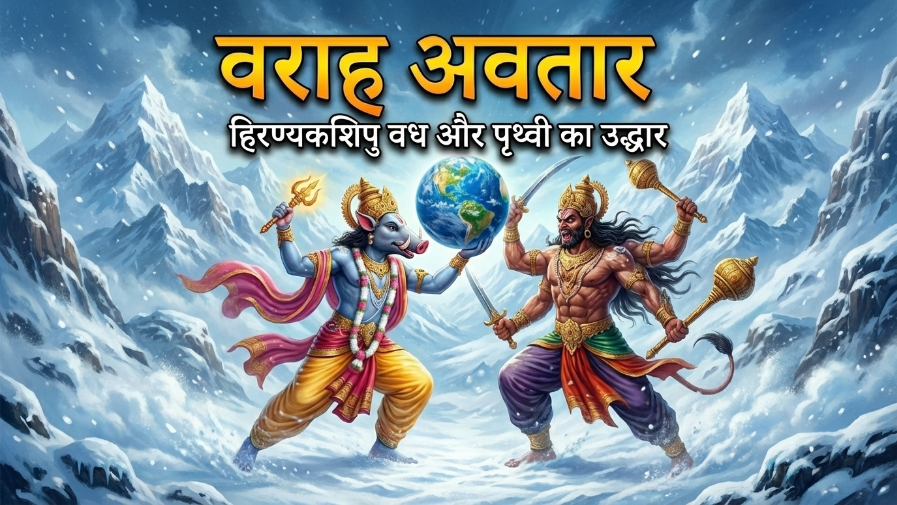
The story of Varaha, known as the Varaha Avatar, represents the rescue of Earth and restoration of balance. This video explains how Lord Vishnu lifted the Earth from cosmic waters and defeated evil forces.
▶ Watch the video below to understand the deeper meaning of Varaha Avatar.
Below Video:
Varaha Avatar symbolizes protection and restoration of life. Continue the journey through Matsya, Kurma, Narasimha, Vamana, Parashurama, Rama, Krishna, Buddha, and Kalki within the Dashavatara.
👉 Watch: Varah Aawtaar Explained – Cosmic Rescue of Earth”
👉Varaha Avatar symbolizes protection and restoration of life. Continue the journey through Matsya, Kurma, Narasimha, Vamana, Parashurama, Rama, Krishna, Buddha, and Kalki within the Dashavatara.
Emergence from the Cosmic Ocean – A Symbol of Evolution
Varaha does not appear from the sky or descend from heaven; instead, he emerges from the cosmic ocean itself. This detail is deeply symbolic. origin of life in water explained in Matsya Aawtaar , in both mythology and science, represents the origin of life. Modern biology tells us that life began in the oceans, in a primordial environment rich with chemical interactions. Similarly, the Varaha narrative begins in water, reinforcing the idea that existence itself arises from fluid, undifferentiated beginnings.
The form of a boar is equally meaningful. Unlike aquatic creatures, the boar is a land animal, associated with strength, grounding, and the ability to dig and reshape the earth. This transformation from water to a land-based being mirrors the evolutionary transition where life forms gradually moved from aquatic environments to terrestrial ecosystems. Thus, Varah Aawtaar can be seen as a symbolic representation of this evolutionary leap—from fluid existence to structured, grounded reality.
The Battle with Hiranyaksha – Chaos vs Cosmic Order
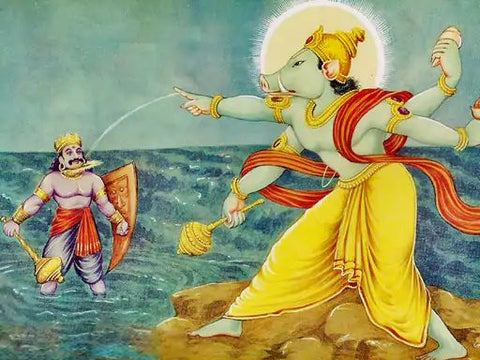
The confrontation between Varaha and Hiranyaksha is not merely a mythological battle; it represents a universal principle—the constant struggle between order and chaos. Hiranyaksha symbolizes uncontrolled forces, imbalance, and the tendency of the universe to fall into disorder. In scientific terms, this can be compared to entropy, the natural drift toward randomness and instability.
Varaha, on the other hand, represents the counter-force—the organizing principle that brings structure, harmony, and balance. When Varaha defeats Hiranyaksha, it signifies the triumph of order over chaos, a necessary condition for the emergence and sustenance of life. Without this balance, no stable systems—biological or cosmic—could exist.
This theme resonates strongly with modern scientific understanding, where the universe is seen as a dynamic interplay between entropy and organization. Life itself exists as a delicate balance between these opposing forces, constantly maintaining order in a universe inclined toward disorder.
Lifting the Earth – The Beginning of Stability and Life
The most iconic moment of Varah Aawtaar is when he lifts the Earth from the depths of the ocean using his tusks. This act is rich with symbolism. The Earth, once submerged and unstable, is raised into a position where it can sustain life. This represents the formation of stable landmasses, the development of ecosystems, and the beginning of a structured environment where life can evolve and flourish.
In philosophical–scientific narrative, this is the stage where the planet becomes habitable. After the initial formation of life in water (as represented by Matsya Aawtaar) and the establishment of stability (as seen in Kurm Aawtaar), Varaha introduces the element of structure and grounding. It is the moment when life is no longer just surviving but begins to organize, diversify, and expand.
Deeper Meaning – Bridging Mythology and Science

Varah Aawtaar stands as a bridge between ancient wisdom and modern scientific thought. It encodes within its narrative a sequence of ideas that align with our current understanding of the universe. The cosmic ocean reflects the primordial state of matter and energy, the emergence of Varaha symbolizes the rise of structured forms, and the lifting of Earth represents the stabilization necessary for complex systems to develop.
From a thermodynamic perspective, this story illustrates how localized order can emerge within a larger system governed by entropy. From an evolutionary standpoint, it reflects the transition from aquatic to terrestrial life. From a philosophical angle, it speaks of the eternal cycle of destruction and restoration, reminding us that chaos is not the end but a phase that precedes creation.
Connecting the Dashavatara Journey
“This evolutionary journey begins with aquatic life in Matsya Avatar, finds balance in Kurma Avatar, and reaches physical grounding in Varaha Avatar before transforming into higher consciousness in Narasimha Avtaar
When viewed as part of the larger Dashavatara sequence, Varah Aawtaar occupies a crucial position. Matsya represents the origin of life in water, Kurm symbolizes the stabilization of the cosmic foundation, and Varaha marks the emergence of structured land and habitable conditions. This progression is not random; it follows a logical and evolutionary pattern that mirrors both biological and cosmic development.
As you build your content series, linking these avatars together strengthens not only SEO but also the intellectual narrative you are creating. Each avatar becomes a chapter in a larger story—the story of life itself unfolding through stages of increasing complexity and awareness.