


Close Menu
lifedevote.comlifedevote.com
    Facebook X (Twitter) Instagram
    Trending
    • Krishna Avatar Story:Divine Love, Wisdom & Meaning of Life
    • Ram Avtaar Story: Vishnu’s Ideal King & Dharma Explained
    • Parashurama Avatar Story: Vishnu’s Warrior Sage Explained
    • Vaman Avtaar story -Vsishnu Explained: King Bali-Three Steps
    • Narasimha Aawtaar: Ego Destruction & Conscious Awakening
    • Varah Aawtaar: The Cosmic Rescue of Earth Vishnu Dashavatara
    • Kurm Aawtaar: Samudra Manthan & Vishnu’s Turtle Form
    • Dashavatara Stotra by Jayadeva : Sanskrit Text with Hindi
    Facebook X (Twitter) Instagram YouTube
    lifedevote.comlifedevote.com
    Demo
    • Home
    • Mythology
    • Philosophy
    • Science
    • Relegion
    • Books
    • Story Tales
    lifedevote.comlifedevote.com
    Home»Mythology»Narasimha Aawtaar: Ego Destruction & Conscious Awakening
    Mythology

    Narasimha Aawtaar: Ego Destruction & Conscious Awakening

    GANPAT VYASBy GANPAT VYASApril 11, 2026Updated:April 12, 2026No Comments9 Mins Read
    Share
    Facebook Twitter LinkedIn Pinterest Email

    Table of Contents

    Toggle
      • Introduction – When Ego Challenged the Universe
              • ▶ Watch the video below to understand the deeper meaning of Narasimha Avatar.
      • 🧬 The Story of Narasimha Aawtaar– Conflict Between Ego and Truth 
      • ⚡ The Emergence – Consciousness Beyond Logic Narasimha Aawtaar
      • 🧠 Deeper Meaning – The Psychology of Ego-
      • 🔥 Symbolism of the Half-Man Half-Lion Form-Narasimha Aawtaar
      • Connection in Dashavatara Evolution in Narasimha Aawtaar
      • 🌐 Modern Interpretation of Narasimha Aawtaar– Relevance Today
      • 🛕 Prominent Narasimha Temples in India
      • 📌 Conclusion – The Moment of Awakening
    • What We Learn from Narasimha Aawtaar
        • 🔗
      • Explore Detailed Vishnu Avatars

    Introduction – When Ego Challenged the Universe

    What if the greatest threat to existence is not external chaos, but the rise of unchecked ego within? “From the early stages of existence seen in Matsya Avatar to stability in Kurma Avatar and Varah Avtaar, this story tells mainly the psychological conflicts.”The story of Narasimha Aawtaar presents a profound moment in this cosmic journey where power, identity, and illusion collide with truth and consciousness. Long before modern psychology explored the concept of ego and self-awareness, this ancient narrative revealed how imbalance arises when power disconnects from truth. According to the story, the demon king Hiranyakashipu, after gaining immense strength through penance, began to see himself as the ultimate authority in the universe. His arrogance grew to such an extent that he denied the presence of any higher reality and demanded absolute obedience. In response to this distortion of balance, Lord Vishnu manifested as Narasimha—a form that was neither man nor animal, neither bound by logic nor limitation—symbolizing the sudden and powerful emergence of consciousness that destroys illusion and restores truth.

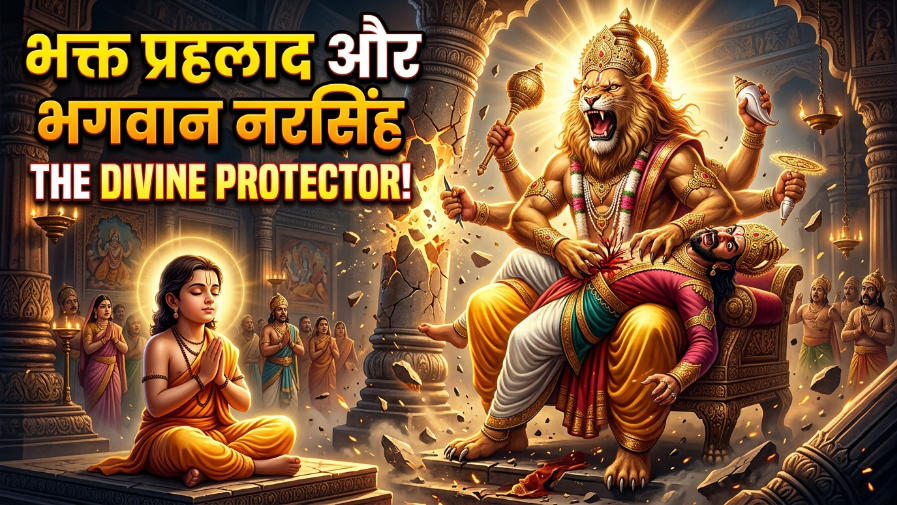
    The story of Narasimha, known as the Narasimha Avatar, represents divine protection and justice. This video explains how Lord Vishnu appeared in a fierce form to protect Prahlad and destroy evil.

    ▶ Watch the video below to understand the deeper meaning of Narasimha Avatar.

    Narasimha Avatar teaches that divine protection always prevails. Continue through Matsya, Kurma, Varaha, Vamana, Parashurama, Rama, Krishna, Buddha, and Kalki in the Dashavatara journey.

    🧬 The Story of Narasimha Aawtaar– Conflict Between Ego and Truth 

    e narrative of Narasimha Aawtaar unfolds as a deep symbolic conflict between two opposing forces: ego and awareness. Hiranyakashipu represents the extreme form of ego, a state where identity becomes inflated and disconnected from reality. Empowered by a boon that made him nearly invincible, he believed he could control existence itself. This illusion of invulnerability reflects a universal human tendency—the desire to dominate, control, and define reality according to one’s own perception.

    In contrast stands Prahlad, his son, who represents unwavering faith and inner alignment with truth. Despite being surrounded by power and fear, Prahlad remained devoted to Vishnu, symbolizing the presence of consciousness that exists beyond external influence. His calmness and conviction illustrate that truth is not dependent on circumstances; it is an inner state of awareness. The tension between Hiranyakashipu and Prahlad is not merely a mythological event—it mirrors the internal struggle within every individual between ego-driven identity and deeper awareness.

    ⚡ The Emergence – Consciousness Beyond Logic Narasimha Aawtaar

    The most dramatic moment occurs when Hiranyakashipu challenges Prahlad by asking whether his God exists in a simple pillar. This question reflects the ego’s attempt to limit reality within its own understanding. When Prahlad affirms that divinity exists everywhere, Hiranyakashipu strikes the pillar in anger. At that very moment, Narasimha emerges from it—shattering not just the pillar, but the illusion of control itself.

    This emergence is deeply symbolic. Narasimha appears at twilight, a time that is neither day nor night, and manifests in a form that is neither human nor animal. He confronts Hiranyakashipu at the threshold, which is neither inside nor outside. Every aspect of this moment transcends binary logic, demonstrating that truth cannot be confined within rigid categories. It shows that when ego creates limitations, consciousness emerges in a form that dissolves those very boundaries.


    🧠 Deeper Meaning – The Psychology of Ego-

    Narasimha Aawtaar is a profound exploration of the psychology of ego and its inevitable collapse. Hiranyakashipu symbolizes the constructed identity that seeks permanence and control, while Prahlad represents the deeper awareness that remains connected to truth. When ego dominates, it suppresses this awareness, creating imbalance and conflict. However, this suppression cannot last indefinitely.

    Narasimha represents the moment of awakening—the sudden realization that breaks down false identity. This process can be intense and even destructive, as it dismantles the structures that ego has built. Yet, it is also liberating, as it reveals a deeper, more authentic state of being. In modern psychological terms, this can be seen as the dissolution of the false self and the emergence of true self-awareness.

    🔥 Symbolism of the Half-Man Half-Lion Form-Narasimha Aawtaar

    Narasimha Aawtaar
    Incarnation of Narsingh Awtaar from Pillar as challanged by father of Bhakt Prahlat

    The 10 Avatars of Lord Vishnu: Dashavatara Explained

    The unique form of Narasimha carries deep evolutionary and philosophical significance. The lion represents instinct, power, and raw survival energy, while the human aspect represents intelligence, awareness, and self-reflection. The combination of these two elements symbolizes a critical transition in the journey of life—from purely instinctual existence to conscious awareness.

    In your broader Origin of Life framework, this stage represents the awakening of mind. After the establishment of physical structure in Varah Aawtaar, Narasimha introduces the dimension of consciousness. Life is no longer just about survival; it becomes about perception, identity, and meaning. This transition marks a turning point where evolution becomes not only biological but also psychological.

    Connection in Dashavatara Evolution in Narasimha Aawtaar

    This evolutionary journey begins with aquatic life in Matsya Avatar, finds balance in Kurma Avatar, and reaches physical grounding in Varah Avtaar, before transforming into higher consciousness in Narasimha avtaar.

    When viewed as part of the Dashavatara sequence, Narasimha Aawtaar occupies a pivotal position. It follows the stages of physical evolution and introduces the realm of consciousness. The sequence unfolds logically: life begins in water, stabilizes, forms structure, and then awakens into awareness. Narasimha represents this awakening, where existence becomes self-aware and capable of reflection.

    This continuity is essential for both storytelling and SEO. Linking Narasimha Aawtaar with previous avatars like Matsya, Kurm, and Varah strengthens the narrative flow and establishes your content as a cohesive series rather than isolated posts.


    🌐 Modern Interpretation of Narasimha Aawtaar– Relevance Today

    In today’s world, the message of Narasimha Aawtaar is deeply relevant. Modern society often encourages the growth of ego through power, success, and external validation. However, this story reminds us that such growth, if disconnected from truth, leads to imbalance. It teaches that true strength lies not in domination but in awareness.

    The story also highlights that transformation often comes suddenly and powerfully. Just as Narasimha appears unexpectedly, moments of realization in life can break long-held illusions and bring clarity. These moments, though intense, are necessary for growth and evolution.

    🛕 Prominent Narasimha Temples in India

    The spiritual energy of Narasimha Aawtaar is not limited to ancient texts—it continues to live through some of the most powerful temples across India, where devotion, mythology, and cosmic symbolism converge. Among the most significant is Ahobilam Narasimha Temple in Andhra Pradesh, a sacred site nestled in the Eastern Ghats, where it is believed that Lord Narasimha actually manifested to destroy Hiranyakashipu. This region is unique because it houses the famous Nava Narasimha temples, representing nine different forms of the deity, each symbolizing a different state of divine energy—from fierce protection to calm grace . Another highly revered temple is the Simhachalam Varaha Lakshmi Narasimha Temple near Visakhapatnam, where Vishnu is worshipped in a combined form of Varaha and Narasimha, symbolizing both the rescue of Earth and the protection of devotion .

    Ahobilam,Blessed with sacred dream of Sri Narasimha - Nava Narasimha Darshan
    Ahobilam Narasimha Temple in Andhra Pradesh,
    Varaha Lakshmi Narasimha Temple, Visakhapatnam - Tripadvisor
    Varaha Lakshmi Narasimha Temple, Visakhapatnam – Tripadvisor

    In Telangana, the Yadagirigutta (Yadadri) Lakshmi Narasimha Temple stands as a powerful center of faith, believed to be a self-manifested (swayambhu) form of Narasimha, attracting thousands of devotees seeking protection and spiritual strength. Similarly, the Panakala Narasimha Temple in Mangalagiri is famous for its unique ritual where the deity is offered a jaggery drink (panakam), symbolizing the calming of Narasimha’s fierce energy . Across India, from Karnataka to Tamil Nadu and Maharashtra, numerous Narasimha temples reflect different aspects of this avatar, reinforcing the idea that Narasimha is not just a mythological figure but a living spiritual force experienced through devotion and sacred geography .

    These temples together represent a deeper truth: that the energy of Narasimha—protection, transformation, and the destruction of ego—is not confined to a single event in time but continues to manifest wherever faith and truth are upheld.

    📌 Conclusion – The Moment of Awakening

    Narasimha Aawtaar represents a turning point in the journey of life—from physical existence to conscious awareness. It teaches that ego, no matter how powerful, cannot sustain itself against truth. When illusion reaches its peak, consciousness emerges to restore balance. This is not just a mythological event but a universal principle that operates at every level of existence.

    👉 In the evolution of life and consciousness, this is the moment where awareness is born—where existence begins to know itself.

    What We Learn from Narasimha Aawtaar

    Narasimha Aawtaar teaches that the greatest imbalance in life does not arise from external chaos but from the unchecked growth of ego within. When identity becomes rigid and disconnected from truth, it creates illusion, conflict, and suffering, just as Hiranyakashipu’s arrogance led to his downfall. The story reveals that consciousness cannot be suppressed indefinitely; like Narasimha emerging from the pillar, awareness appears at the peak of illusion and breaks it completely. It also shows that truth is not limited by logic, rules, or categories—it exists beyond them and manifests in ways the ego cannot predict. At a deeper level, this avatar represents a crucial stage in the evolution of life, where existence moves beyond mere survival and begins to awaken into self-awareness. Ultimately, Narasimha Aawtaar reminds us that real strength lies not in control or dominance, but in alignment with truth, and that every illusion, no matter how powerful, is destined to dissolve in the light of consciousness.

    FAQ (Add for SEO Boost)

    What is Narasimha Aawtaar?
    It is the fourth avatar of Vishnu representing the destruction of ego and awakening of consciousness.

    Why is Narasimha neither man nor animal?
    To show that truth exists beyond logical categories and limitations.

    What does Prahlad symbolize?
    He represents inner awareness, faith, and connection to truth.

    What is the main lesson of Narasimha Aawtaar?
    That ego ultimately collapses, and consciousness always prevails.

    🔗

    Explore Detailed Vishnu Avatars

    To understand the deeper meaning, stories, Stotra  and symbolism of each incarnation, explore the detailed articles on the 10 avatars of Vishnu below. Each post explains the philosophy, scientific insight, and spiritual significance of the Dashavatara in depth.

    • 👉 Matsya Aawtaar –
      👉 Kurm Aawtaar 
      👉 Varah Aawtaar 
      👉 Vaman Aawtaar 
      👉 Parashuram Aawtaar 
    • 👉 Ram Avtaar
    • 👉 Krishna Awtaar
    • 👉 Budha Avtaar
    • 👉 Kalki Avtaar
    • 👉 Dashavtaar stotra
    • Narasimha Aawtaar consciousness awakening ego destruction Hindu mythology meaning Narasimha Avatar story Prahlad and Hiranyakashipu science and spirituality Vishnu Dashavatara
    Share. Facebook Twitter Pinterest LinkedIn WhatsApp Reddit Tumblr Email
    GANPAT VYAS
    • Website

    I am Ganpat Lal Vyas son of late Shri Madan Lal Vyas and late Smt Rukmani Devi. Curiosity has always been the guiding force of my life. I am a science graduate with post-graduation in economics and served in banking for my livelihood. From my early studies, especially science, I was deeply inspired to explore beyond textbooks and classrooms. Though professional life limited deep academic pursuit, the thirst to know never faded. After retirement, I am free to explore the unknown realms of science, philosophy, and existence. This website reflects my lifelong journey of inquiry and learning.

    Related Posts

    Krishna Avatar Story:Divine Love, Wisdom & Meaning of Life

    April 12, 2026

    Ram Avtaar Story: Vishnu’s Ideal King & Dharma Explained

    April 12, 2026

    Parashurama Avatar Story: Vishnu’s Warrior Sage Explained

    April 11, 2026
    Leave A Reply Cancel Reply

    Pick Your Language
    Facebook X (Twitter) Instagram Pinterest
    © 2026 ThemeSphere. Designed by ThemeSphere.

    Type above and press Enter to search. Press Esc to cancel.