



Introduction: Why Kurm Aawtaar is the Foundation of Balance
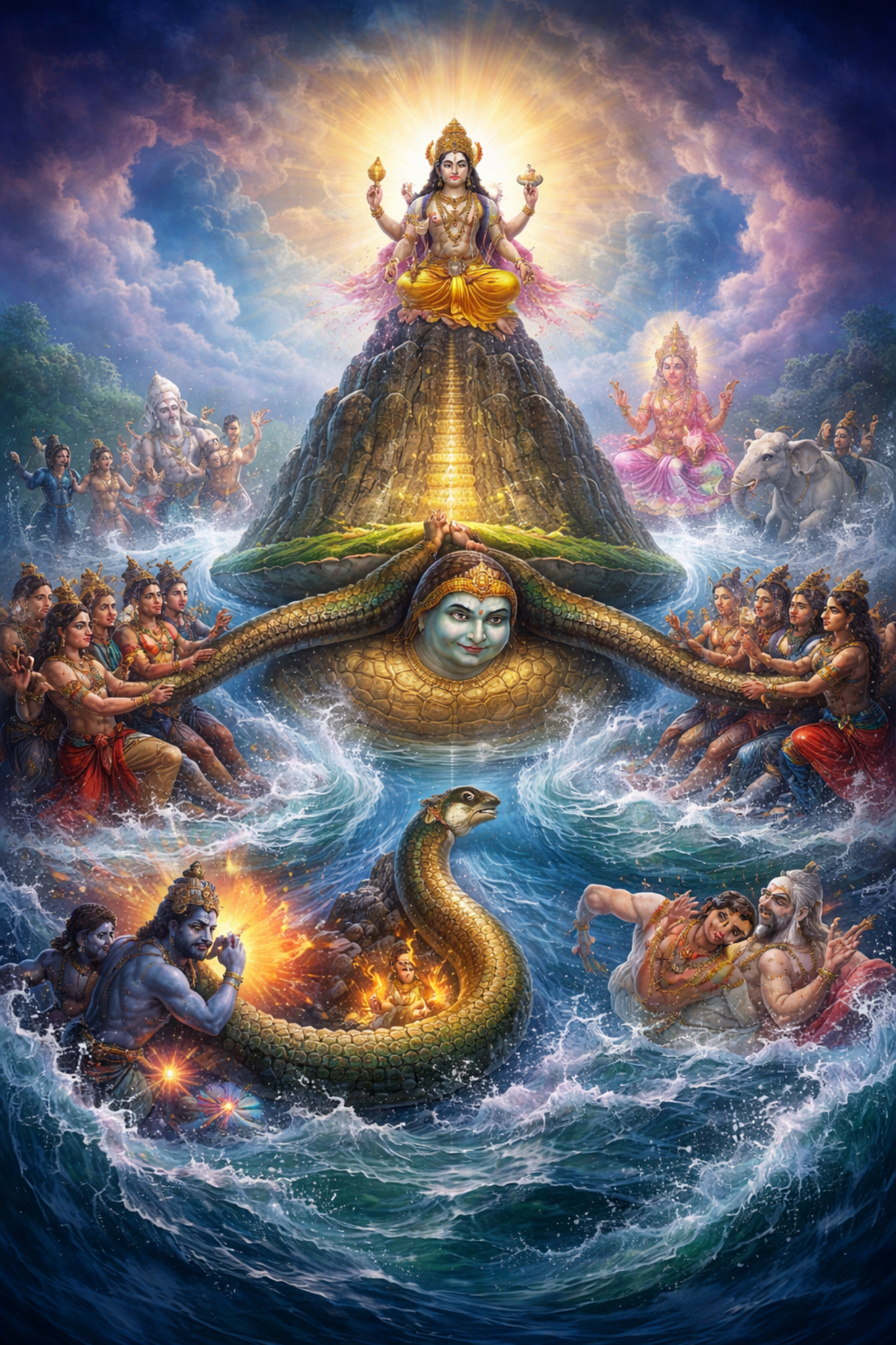
What is Kurm Awtaar- The Kurm Aawtaar is the second incarnation of Vishnu in the Dashavatara sequence. It represents one of the most powerful cosmic events in Hindu philosophy—the Samudra Manthan.
“Kurm Aawtaar reminds us that every transformation needs a strong and silent foundation.”
In this form, Vishnu takes the shape of a giant turtle to support the entire process of creation. This is not just a story—it is a profound symbol of stability, energy balance, and transformation.
👉Explore all 10 avatars of Vishnu
What if the story of Kurm Aawtaar is not just mythology, but the hidden foundation behind every transformation in the universe?
👉Watch the video below to understand the deeper meaning of Kurma Avatar.
👉 Kurma Avatar teaches the importance of patience and balance in times of change. Explore further through Matsya, Varaha, Narasimha, Vamana, Parashurama, Rama, Krishna, Buddha, and Kalki in the journey of Dashavatara.
The story of Kurm Aawtaar is deeply connected to the cosmic event of Samudra Manthan. According to scriptures, the Devas lost their strength due to a curse given when divine respect declined, leading to imbalance in the universe. To regain power, both Devas and Asuras decided to churn the ocean of milk. Mount Mandara was used as the churning rod and Vasuki as the rope, but as the process began, the mountain started sinking. At that moment, Vishnu took the form of Kurm Aawtaar and supported the mountain, enabling the emergence of divine elements including Amrit.

According to ancient scriptures, both Devas (gods) and Asuras (demons) sought the nectar of immortality—Amrit.To obtain it, they decided to churn the cosmic ocean. They used Mount Mandara as the churning rod and the serpent Vasuki as the rope. However, as the churning began, the mountain started sinking into the ocean. At this critical moment, Vishnu incarnated as Kurm Aawtaar—a giant turtle—and supported the mountain on his back.With this stable base, the churning continued, leading to the emergence of many divine elements, including the nectar of immortality.
Before Kurm Aawtaar, Vishnu appeared as 👉Matsya Aawtaar , representing life in water.
Symbolic Meaning of Kurm Aawtaar
The Kurm Aawtaar carries deep philosophical insights:
- Stability is the Base of Creation
Without a strong foundation, no transformation is possible. The turtle represents patience, grounding, and support.
- Balance Between Opposites
Devas and Asuras represent positive and negative forces. Creation happens when both forces interact.
- Hidden Support System
Just like the turtle remains beneath the surface, true strength often works silently in the background.
Scientific Interpretation of Kurm Aawtaar
The Kurm Aawtaar can be seen as a symbolic representation of scientific principles:
- Stability is required for any process (like a base in physics)
- Energy extraction requires friction and motion
- Complex systems evolve through interaction of opposing forces
The churning of the ocean can be compared to processes where energy and matter interact to produce new elements.
Philosophical Insight: The Inner Churning
The Kurm Aawtaar of Vishnu represents the principle of stability beneath transformation. Just as the cosmic process of Samudra Manthan required a strong and unseen foundation, life itself depends on inner balance and patience. The turtle symbolizes the ability to remain grounded even during intense change, teaching that growth is possible only when supported by a stable base. Philosophically, Kurm Aawtaar reflects the idea that true strength often works silently in the background, sustaining both the outer world and the inner journey of consciousness.
Samudra Manthan is not just a cosmic story—it represents the inner churning of human consciousness. The ocean symbolizes the mind, Mandara represents effort, and Vasuki signifies the forces of desire and struggle.
The emergence of poison before nectar teaches that challenges and negativity arise before transformation. Only through patience, balance, and guidance can one achieve higher awareness.
Samudra Manthan is not only a cosmic event—it also represents the inner churning of the human mind.
Within us, there are opposing forces:
- Desire vs Discipline
- Ego vs Wisdom
When these forces are balanced, higher awareness (Amrit) emerges.
Connection to Matsya Avatar and Evolution
The Kurm Aawtaar follows the Matsya Avatar in the Dashavatara sequence:
- Matsya → Life in water
- Kurm → Transition between water and land
This progression reflects the evolutionary journey from aquatic to amphibious life forms.
Why Kurm Aawtaar is Still Relevant Today
In today’s fast-moving world, the lesson of Kurm Aawtaar is crucial:
- Stay grounded during chaos
- Build strong foundations
- Balance opposing forces
Without stability, growth is impossible.
Why Samudra Manthan: The Cosmic Churning of the Ocean

The episode of Samudra Manthan is one of the most profound cosmic events described in Hindu scriptures, symbolizing the process of creation, conflict, and transformation. When the Devas lost their strength due to a curse on Indra, they approached Vishnu for guidance. Vishnu advised them to collaborate with the Asuras and churn the Kshira Sagara (Ocean of Milk) to obtain Amrit—the nectar of immortality.
For this grand task, Mount Mandara was used as the churning rod and the serpent king Vasuki served as the rope. As the churning began, the mountain started sinking into the ocean, and at this critical moment, Vishnu incarnated as Kurm Aawtaar, supporting the mountain on his back and stabilizing the entire process.
As the churning intensified, several divine and powerful elements emerged, each carrying deep symbolic meaning: These are Cosmic Symbol of Prosperity even today for Health Wealth and Happiness.
- Halahala poison, consumed by Shiva (Neelkanth)
- Goddess Lakshmi, symbolizing prosperity
- Kamadhenu (divine cow), representing abundance
- Airavata (celestial elephant), symbol of strength
- Kaustubha gem, worn by Vishnu
- Amrit (nectar of immortality), the ultimate goal
What Samudra Manthan Teaches Us
- Transformation requires effort and stability
- Opposing forces can create progress
- Inner struggles lead to higher wisdom
- True rewards come after enduring difficulties
Conclusion: Kurm Aawtaar as the Backbone of Creation
The Kurm Aawtaar is not just a mythological episode—it is the principle of support that sustains all transformation.
It teaches us that behind every great achievement, there is an unseen foundation holding everything together.
What You Have Learned from Kurm Aawtaar
Kurm Aawtaar teaches that every transformation requires a stable foundation. It shows that balance between opposing forces creates progress, and that unseen support systems are essential for growth. The story of Samudra Manthan reminds us that inner and outer conflicts can lead to higher awareness when guided properly.
FAQ
What is Kurm Aawtaar?
Kurm Aawtaar is the second incarnation of Vishnu, where he took the form of a turtle to support the Samudra Manthan.
Why did Vishnu take Kurm Aawtaar?
Vishnu took this form to provide stability and support during the churning of the ocean.
What is the meaning of Samudra Manthan?
It represents the process of transformation through balance and effort.
Explore Detailed Vishnu Avatars
To understand the deeper meaning, stories, Stotra and symbolism of each incarnation, explore the detailed articles on the 10 avatars of Vishnu below. Each post explains the philosophy, scientific insight, and spiritual significance of the Dashavatara in depth.
- 👉 Matsya Aawtaar –
👉 Varah Aawtaar
👉 Narasimha Aawtaar
👉 Vaman Aawtaar
👉 Parashuram Aawtaar - 👉 Ram Avtaar
- 👉 Krishna Awtaar
- 👉 Budha Avtaar
- 👉 Kalki Avtaar
- 👉 Dashavtaar stotra
